Mirrors cut to size in London: getting the order right first time
Mirror is cut once, to the number you give us. This page is about the part you control: the measurement, the deduction, the specification, and the handful of things that cannot be changed after the glass leaves the cutting table.
Why your measurement is the one that counts
A search for mirrors cut to size London throws up plenty of workshops, ours included, and every one of them will cut exactly what you tell it to cut. That sounds obvious until a 1,800mm panel arrives 3mm wider than the alcove and there is nothing anybody can do about it. Mirror cannot be planed, sanded back, trimmed on site or eased in. The number you write down is the number that gets made.
So this page is not a list of what we can do. It is a list of the decisions you are actually making when you send a size, and where those decisions go wrong. We do question orders that look wrong, and we ring people about them regularly, but we cannot see your wall from Wembley.
There is no middle position on who owns the size. If you measure, you own it. If we survey, we own it. Anybody who blurs that line is setting up an argument for later. For a panel over a metre, or anything going into a recess, a free survey costs less than one remake and takes half an hour.
The measuring situations that catch people out
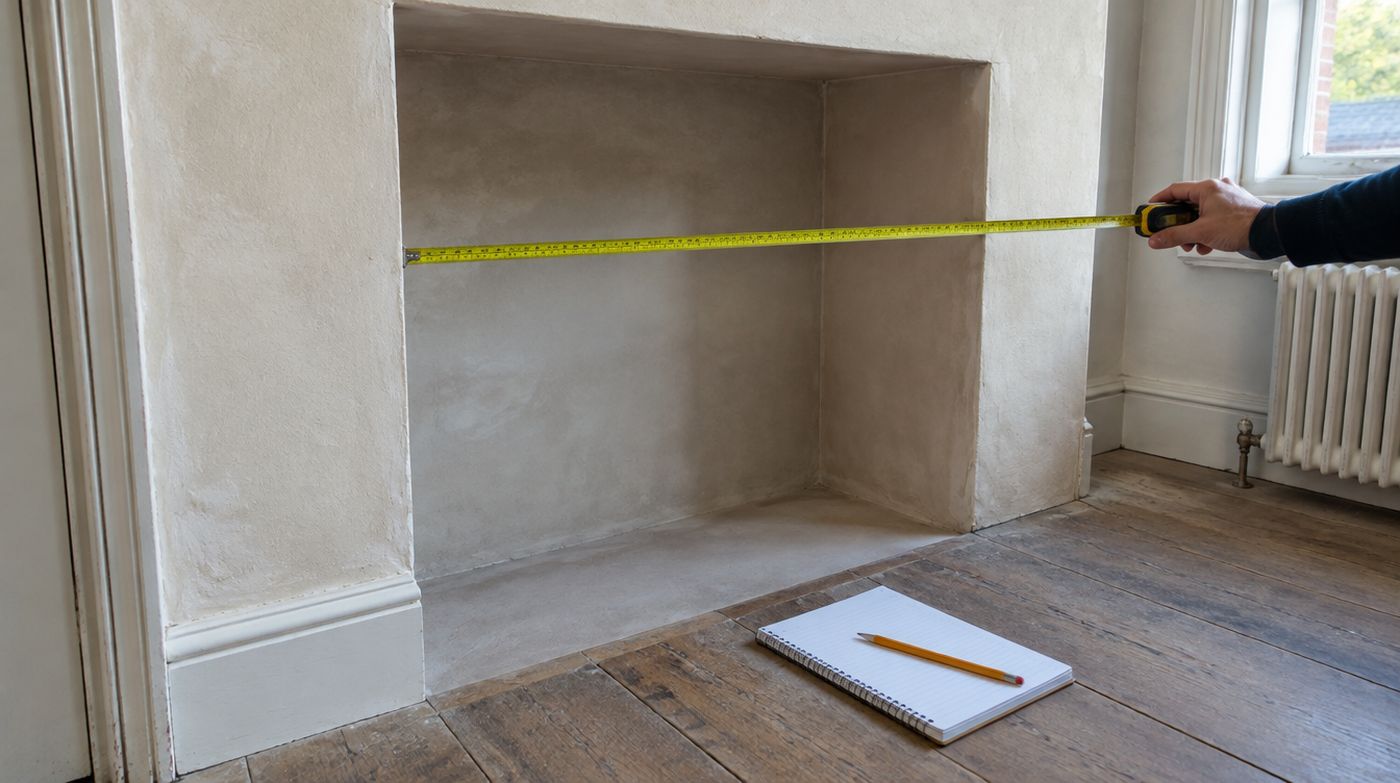
Measuring a chimney breast alcove is covered properly on our made to measure mirrors page, because it is the one job where the opening is almost never square and the method matters. These are the other four situations, and between them they account for most of the sizes we have to query.
A mirror on an open wall
Nothing constrains the size, so people give a round number and then find the finished panel fights the room. Before you decide, mark the outline on the wall in low-tack tape and leave it up for a day or two. Set it out from whatever the mirror has to relate to, which is usually the furniture below it or the width of the chimney breast, not the centre of the wall. Walls in London houses are rarely symmetrical once you allow for a radiator, a return and a badly placed socket.
Between two fixed points
Returns, the space between two wardrobes, the run between a worktop and the wall units. Measure at three heights and use the smallest figure, because almost nothing in an older house is parallel. Then take something off. We would deduct 3mm each side up to about 1.2m, and 5mm each side beyond that. People deduct nothing because they want a tight line with no shadow gap, and a tight line with no tolerance is a panel that will not go in.
A wardrobe or cupboard door
Measure the door, not the opening, and tell us whether the mirror sits on the face of the door or into a rebate. Then think about the hinges. Glass weighs roughly 2.5kg per square metre for every millimetre of thickness, so a 1,700 by 500 panel in 4mm adds something like 8kg to a door that was hung for a sheet of MDF. On a tall door that is the difference between a door that stays shut and one that drops on its hinges within a month. Sliding wardrobe fronts have their own track weight limits, which are usually printed inside the top track.
A panel behind a worktop
Worktops are rarely dead straight and wall junctions are rarely square, so anything sitting on a worktop should be templated rather than measured. Whether mirror can go behind your hob at all is a separate question and it is answered in our FAQ. Assume the position needs assessing rather than assuming it will be fine.
What a complete mirror order says
Six things, and if any of them are missing we will come back to you, which costs a day. Most of the delay in cut to size work is not production. It is the back and forth before production starts.
- Finished sizes, stating clearly which figure is the width as you look at the mirror.
- Thickness, which for domestic work is almost always 4mm or 6mm.
- Edge finish, and which edges it applies to.
- Backing: plain mirror, or mirror with a safety backing.
- Holes, notches and cut-outs, each dimensioned from two named edges, with a sketch.
- Whether you are collecting, we are delivering, or we are fitting.
The one that causes real trouble is cut-out positions. A note saying centre, 300 down means nothing on a panel that is not symmetrical, and it means nothing at all if we cannot tell which way up the sketch is. Dimension every hole from the bottom edge and the left-hand edge as you face the mirror, and write that convention on the drawing. It takes an extra minute and it removes the single commonest cause of a remake.
Thickness, edge and backing: the short version
Each of these has a full section on the made to measure mirrors page, so here is only what you need in order to place an order. Four millimetre mirror is right for anything up to roughly a square metre. Six is right above that, anywhere the panel will be handled by people who are not glaziers, and anywhere flatness matters, because thin mirror in a big sheet flexes and flex is what you see as a wave in the reflection.
Edges come polished, bevelled or arrissed. Polished is a flat, finished, slightly shiny edge you can run a hand along. Arrissed is the cut edge with the sharpness taken off, which is all you need where the edge is hidden. A bevel is a decorative chamfer ground into the front face, and it costs considerably more than a polish.
That leads to the first thing we will talk you out of. If your mirror is going into an alcove, behind a wardrobe door, or butted against another panel, nobody will ever see the edge. Paying for a bevel on all four sides of a panel whose edges are covered is money straight down the drain, and we will say so before we quote it.
What cannot be changed once the mirror is cut
A panel can be cut down. It cannot be made bigger, and cutting it down means re-polishing the fresh edge, which on a small panel costs about what a new small panel costs. Holes and cut-outs cannot be moved. A bevel cannot be added without losing size at every edge. Safety backing cannot be applied afterwards in any way we would put our name to.
Which is why we send every set of sizes back to you in writing before anything is cut, and why we would rather you spent two minutes reading that confirmation than ten minutes on any other part of this page. If a figure on it looks wrong to you, it probably is.
Collection, delivery or fitting
You can collect from the workshop in Wembley. If you do, bring something the panel can stand upright in. Mirror travels on its edge, on a blanket, leaning slightly back against something solid, never flat. Glass laid flat in the back of an estate car flexes over every speed hump between here and home, and flexed mirror breaks from the middle of an edge for no visible reason.
We deliver mirrors cut to size London wide. Panels go out wrapped and carried on edge, somebody has to be in, and there has to be a sensible place to stand it that is not a hallway everybody is using. If you are on the fourth floor of a block with a small lift, tell us at quote stage rather than on the morning.
Fitting is the part most people assume they need and often do not. A 600 by 900 panel with two drilled holes going into solid brick is half an hour of work for anybody competent with a drill, and paying a fitting charge for it is waste. Fitting earns its money on panels over about 1.2m, anything going into a tight recess, anything on plasterboard or stud, and all gym and bathroom work. Which fixing suits which wall is covered on our wall mirrors cut to size page.
What mirrors cut to size London prices actually depend on
Area and thickness are the obvious ones. The less obvious one is edge work, which is priced by the metre run, so a long thin panel costs more per square metre than a square one of the same area. Then every hole and cut-out is priced individually, backing adds to the sheet cost, and anything that is not a rectangle needs a template and more machine time.
If one quote comes back much cheaper than the others, look at the thickness and the backing before you assume you have found a bargain. Four millimetre plain mirror where everyone else quoted 6mm safety backed is not the same product, and a quote that does not state thickness and backing is not a quote.
Where people overspend: ordering 6mm because it sounds better on a panel small enough that 4mm is correct and easier to fix, specifying safety backing on a small mirror screwed through into brick where it adds nothing, and buying bevels on hidden edges. Where people underspend: leaving safety backing off a gym wall, and buying ordinary mirror for a bathroom. The second list costs far more than the first.
Lead time, and the bit nobody plans for
Cutting takes minutes. Edge work, drilling and any processing queue behind other jobs, and shaped work has to be templated before any of it starts. Plan in days rather than hours, and if the mirror has to be in before a date, say the date at the start rather than at the end.
The other thing to plan is the order of works. Mirror goes on last. If the wall is being plastered or painted, it needs to be dry and cured before anything is bonded to it, and fresh plaster takes longer to be properly dry than it takes to look dry. A mirror bonded to a green wall is a mirror that comes off the wall in six months, usually at night.
FAQ
Questions about mirrors cut to size london
How much should I take off my measurement when ordering a mirror?
For a panel going between two fixed points, deduct about 3mm from each side up to roughly 1.2m, and about 5mm each side above that. Measure the opening at three heights and base the deduction on the smallest figure, because walls and returns are rarely parallel. On an open wall where nothing constrains the panel, no deduction is needed. People routinely deduct nothing because they want a tight shadow-free line, and a panel cut to the exact opening will not go in, because mirror cannot be eased, trimmed or flexed into place on site.
Can a mirror be cut down after it has been made?
Yes, but it is rarely economic. The panel can be cut smaller, and the fresh edge then has to be re-arrissed or re-polished to match the others, which is most of the labour in a small panel anyway. It cannot be made larger, holes and cut-outs cannot be moved, and a bevelled edge cannot be recreated without losing further size on every side. On anything small, cutting down costs close to the price of a replacement. That is why we confirm every set of sizes in writing before cutting.
How long does it take to get a mirror cut to size in London?
The cutting itself takes minutes. What sets the lead time is edge polishing, drilling, any safety backing and the queue of work in front of yours, so think in working days rather than hours. Shaped or templated panels take longer because the template has to be made and checked first. The delay we see most often is not production at all: it is the days spent confirming sizes and cut-out positions. Send a complete order with a dimensioned sketch and you remove most of the wait.
Send your mirror sizes
Tell us the size, where it is going and how it will be fixed. We will confirm the backing and edgework and quote in writing.