Areas we cover across London
We work from our workshop at 6 Atlas Road, Wembley HA9 0JH, across Greater London and the near Hertfordshire border.
Core coverage
Where most of our work is
Being based in Wembley means north, west and central London are on our doorstep. These are the areas we are in most weeks.
- Wembley
- Harrow
- Brent
- Ealing
- Camden
- Westminster
- Kensington & Chelsea
- Hammersmith & Fulham
- Barnet
- Islington
- City of London
- Watford
Full list
Every area we survey and install in
- Wembley
- Harrow
- Brent
- Ealing
- Acton
- Willesden
- Kilburn
- Camden
- Islington
- Westminster
- Marylebone
- Fitzrovia
- Mayfair
- Kensington
- Chelsea
- Hammersmith
- Fulham
- Chiswick
- Shepherd's Bush
- Notting Hill
- Maida Vale
- St John's Wood
- Hampstead
- Highgate
- Finchley
- Barnet
- Mill Hill
- Edgware
- Stanmore
- Pinner
- Northwood
- Ruislip
- Uxbridge
- Hayes
- Southall
- Greenford
- Wood Green
- Enfield
- Walthamstow
- Hackney
- Shoreditch
- City of London
- Clerkenwell
- Southwark
- Battersea
- Wandsworth
- Richmond
- Twickenham
- Kingston
- Watford
- Bushey
- Borehamwood
Not on the list? If you are within the M25 it is worth a call. We travel for larger projects and can usually fit a survey around work already booked nearby.
What we do across these areas
- Made to measure mirrors
- Mirrors cut to size in London: getting the order right first time
- Wall mirrors cut to size: assessing the wall before you order the glass
- Gym mirrors in London: how to get a mirror wall right
- Bespoke bathroom mirrors: the specification that survives a wet room
- Large wall mirrors: the limits that decide the size you can have
- Buying from a mirror glass supplier: grades, tints and supply-only terms
Mirror work in London depends on the building, not the postcode
Bespoke mirror work in London covers an enormous range of buildings, and the thing that decides how a mirror job goes is almost never the area name. It is what the walls are made of, how square the opening is, and whether a two metre panel of glass can physically reach the room. A Victorian terrace in Walthamstow and a Victorian terrace in Clapham throw up the same problems. A mansion block flat in Maida Vale and one in Marylebone throw up a different set. We survey across Greater London from the Wembley workshop and the questions we ask on arrival depend on the housing stock in front of us.
Chimney breast alcoves in Victorian and Edwardian terraces
The single most common bespoke mirror job we do in London is a full height panel in a chimney breast alcove, in a terrace in Islington, Hackney, Walthamstow, Clapham or Balham. These recesses are wonderful places for a mirror and awful places to measure. The brickwork was laid by eye, the plaster has been patched and skimmed repeatedly, and almost none of them are square, plumb or parallel. It is routine to find 15mm of variation in the width over a two metre height, and a back wall that is noticeably bowed.
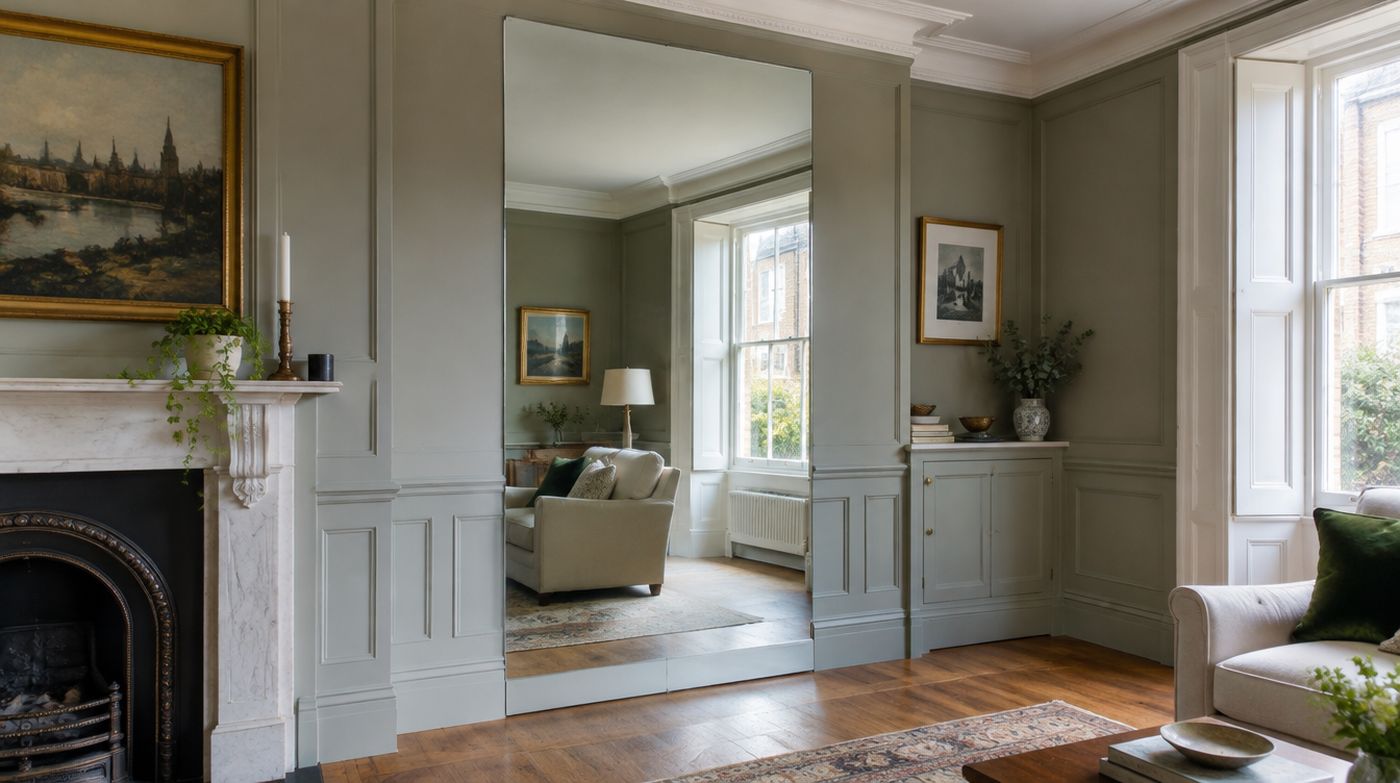
That is why we measure the width at the bottom, middle and top, measure the height at both sides and the centre, and cut to the smallest figure with a tolerance deducted. Where the sides of the recess are visibly out of parallel, we template in hardboard rather than trusting a tape, because a mirror has no tolerance at all once it has left the workshop. The back wall being bowed is a separate problem, and the usual answer in these houses is to batten and ply the recess so the glass has a flat plane to sit against rather than being pulled into the shape of 130 year old plaster.
The other feature of these houses is lath and plaster, which you will find on internal partitions and on chimney breast faces in plenty of unmodernised terraces in Hackney, Walthamstow and the older parts of Islington. Lath and plaster will not reliably hold a bonded mirror. The plaster keys into timber laths with voids behind, it is brittle, and the surface will let go in a sheet. Mirror on these walls needs mechanical fixing into the studs or the laths, or a ply backing screwed back to timber, and that has to be established at survey rather than discovered on fitting day.
Hallway and stairwell mirrors in narrow terraced houses
London terraced hallways are typically between 900mm and 1200mm wide, which is why a mirror does so much for them and also why fitting one is awkward. A full height panel on the long return wall is transformative in a narrow hall, far more effective than a mirror at the end facing the front door. Practically, the problem is that you cannot stand far enough back in a 1 metre hallway to offer up a 2 metre panel, so the mirror has to be brought in on edge and rotated into position in a space that has a staircase on one side.
We plan that rotation before we quote. It decides the maximum panel size, it decides whether the job needs two fitters or three, and it sometimes decides that two butted panels are the right answer rather than one. A stairwell mirror on the half landing has the same issue plus a ceiling slope and a handrail, and is one of the places where we will occasionally say that the panel you want cannot get to the wall you want it on.
Mansion block flats in Maida Vale, Marylebone and Kensington
Period mansion blocks are a specific discipline. The walls in flats around Maida Vale, Marylebone, Kensington and the older St John’s Wood blocks are frequently lath and plaster or soft lime plaster on brick, and neither will take a bonded mirror of any size. We fix mechanically in these buildings as a default: a timber or ply backing screwed through to something solid, with the mirror carried on a bottom support. It is more work than bonding and it is the only approach that respects the fact that these walls were never designed to hold 30kg hanging off their face.
Then there is the building itself. Most blocks have a porter or managing agent, and most have rules: approved working hours, no deliveries through the main entrance at certain times, dust sheets in the communal hall, and a goods lift that has to be booked. Many of the lifts in these buildings are original, which means a car around 1100mm deep with a folding gate, and a 2 metre mirror panel will not go in it. That leaves the stairs, and mansion block stairs are generous in width but often have tight 180 degree turns around a solid core.
We ask for the lift internal dimensions and a photograph of the stair turn before quoting anything over about 1800mm in these buildings. It is a five minute question that avoids a wasted delivery.
Getting a large mirror up a London staircase
The dimension that actually matters on a staircase is the diagonal, not the width of the treads. A panel has to be turned through the tightest point on the route, usually a half landing or a quarter turn, and what limits it is the clear diagonal available between the newel post, the opposite wall and the ceiling above. A 2200mm panel needs more than 2200mm of clear diagonal space, plus hands on both sides, plus a few hundred millimetres of forgiveness. Measure that diagonal before ordering, and measure it at the height a panel will actually be carried rather than at floor level, because the soffit of the flight above is often the real obstruction.
It is worth understanding why mirror is more fragile to carry than clear glass of the same thickness. Clear glass in large panels is usually toughened, which gives it a great deal of tolerance to flexing and to knocks. Mirror cannot be toughened after silvering, so a mirror panel is annealed float glass. Annealed glass breaks from edge damage and it breaks when flexed. A toughened panel the same size would bend visibly and survive. A mirror panel bends a little and then goes, usually from a tiny nick in the edge that happened on the previous job.
On top of that, the back is a painted coating. A mirror can be carried, fitted, and look perfect, and still be damaged because something pressed a grain of grit against the back on the way up. That is why our panels travel faced and padded, why we carry mirror vertically on edge rather than flat, and why we will decline to carry a panel up a route we think it cannot survive and propose a split instead.
Home gyms in garages and lofts across Barnet, Harrow, Stanmore and Richmond
Home gym mirrors in London increasingly mean a converted garage or a loft in the outer boroughs. In Barnet, Harrow, Stanmore and Richmond we fit a lot of large wall mirrors into 1930s semis and detached houses where the garage has been lined out and turned into a training space. Garages bring three issues: the wall is usually blockwork or plasterboard on battens with voids behind, the space is unheated so it goes through real temperature swings, and there is often residual damp in the slab and the lower courses of the wall.
Our answer is a ply backing sheet screwed back to the structure, a flat plane built on it, 6mm mirror with safety backing film, a bottom support carrying the dead load, and a kicker gap of 100mm to 150mm so the bottom edge is clear of floor moisture and of anything being dropped. In a garage we never bond mirror directly to a cold, possibly damp, blockwork wall.
Lofts are a different problem. The wall available is usually a dwarf wall with a slope above it, so the usable height for mirror is limited and needs checking against where somebody will actually be standing. The bigger constraint is the hatch. A loft conversion with a proper staircase is fine. A room reached through a 760mm by 600mm opening will not accept a single large panel, full stop, and the honest answer there is multiple narrower panels butted on the wall. We would rather tell you that at survey than turn up with glass that cannot get in.
New-build apartments in Wembley Park, Stratford and Nine Elms
New-build flats in Wembley Park, Stratford, Nine Elms and the other recent developments have walls that look solid and are not. Internal partitions are generally metal stud with plasterboard, and external walls are commonly plasterboard dot and dabbed onto blockwork or onto the concrete frame. Neither will hold a bonded mirror of any serious size, and the failure mode with dot and dab is the board coming away from the wall with the mirror attached.
So in these flats we locate the studs with a detector, fix a timber or ply backing into them or through the board into the masonry behind with the fixings properly packed, and bond the mirror to that. Where the wall is a concrete shear wall or part of a post-tensioned slab arrangement we take the drilling question seriously and will ask the building management what can and cannot be drilled, because tendons and conduits are not things to find by accident.
The logistics in these buildings are usually easier than in a period block and more bureaucratic. There is a loading bay with time-limited slots, a goods lift that has to be booked with the concierge, protective coverings required in lift cars and corridors, and sometimes a requirement for proof of insurance before anybody is allowed up. All of that is fine when it is arranged in advance and a complete waste of a day when it is not, so we book it when we book the fitting.
Bathroom mirrors in internal London bathrooms
Flat conversions all over inner London, and nearly every new-build apartment, have at least one bathroom with no window. Those rooms destroy mirrors. Steam has nowhere to go, condensation runs down the glass face, and water collects along the bottom edge where the backing is exposed on the cut arris. We see edge corrosion in internal bathrooms far more often than anywhere else in a house.
For a bespoke bathroom mirror in a room like this we specify a higher corrosion resistance backing, hold the panel a few millimetres off the wall on standoffs or a batten so air can circulate behind it, set the bottom edge clear of the basin splash zone, and deliberately leave the bottom edge unsealed so anything that gets behind can drain and dry. We also talk about the extractor, because a mirror in an unventilated bathroom is being asked to solve a ventilation problem and it cannot.
Parking, permits and getting glass from the van to the wall
Access is a real cost in London mirror work and we would rather be straight about it. Almost all of inner London is a controlled parking zone with limited or no loading provision, there are red routes where stopping is not allowed at all, there are school streets with timed restrictions, and the congestion charge and ULEZ apply to our vehicles. On narrow terraced streets in Walthamstow, Hackney or Balham, with parked cars both sides and no side access, the van often cannot get within a sensible carrying distance of the front door.
What we ask at survey is simple: where can a van stop, how far is it to the door, how wide is the door, is there a side return, and are there steps. On tight jobs it is sometimes worth the customer arranging a suspended bay or a visitor permit, and on estates it is worth finding out who holds the key to the barrier. None of this is glamorous and all of it is the difference between a two hour fit and a lost morning.
Protecting a finished room
Mirror usually goes in at the end of a project, into a room that has just been decorated, and that shapes how we work. We do not cut mirror on site. Panels arrive finished, faced and padded, which means no cutting dust, no grinding and no swarf in a new carpet. Floors get covered, furniture gets moved or sheeted, and the adhesive and fixings go on with the panel supported rather than balanced against a freshly painted wall.
If the decorators are still to come, tell us. A mirror fitted before the final coat means somebody is cutting in with a brush against a glass edge, which is slower for them and risky for the backing. If a shadow gap or a bead is going round the panel, that detail needs agreeing before the mirror is cut, not afterwards.
We cover Greater London and work most often across north, west and central London, from Wembley, Harrow, Barnet and Stanmore through Maida Vale, Marylebone and Kensington to Islington, Hackney and Walthamstow, and south across the river into Clapham, Balham, Richmond and Nine Elms. For a free survey and a written fixed quotation, call the workshop on 020 4634 6045, Monday to Friday, 8am to 5pm.
Send your mirror sizes
Tell us the size, where it is going and how it will be fixed. We will confirm the backing and edgework and quote in writing.