Gym mirrors in London: how to get a mirror wall right
A gym mirror wall is simple to make and very easy to specify badly. This page covers the heights, the gap at the bottom, how a wide wall is divided into panels, and the one thing we will not supply a gym mirror without.
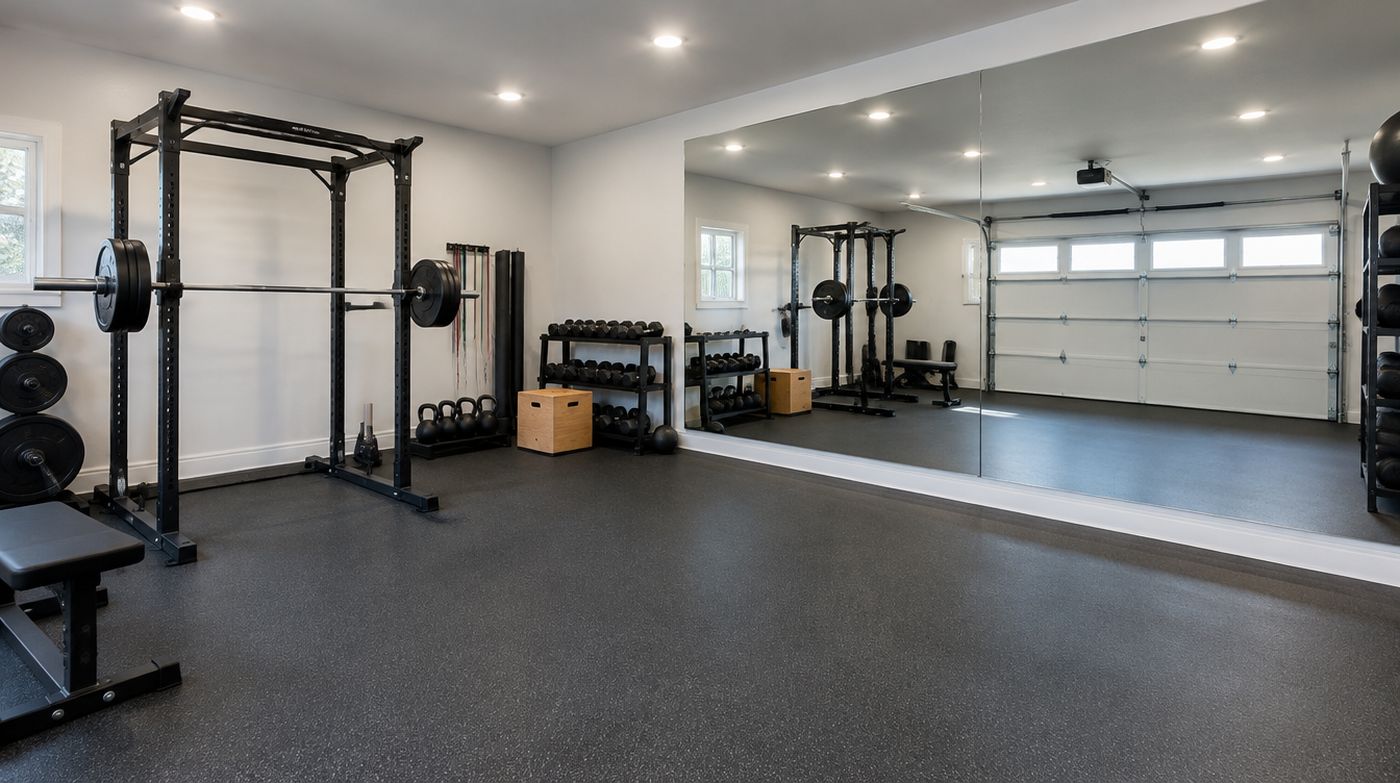
What height should a gym mirror start and finish at?
The first question on any enquiry for gym mirrors London homeowners send us should be about height, not width, because height is what decides whether the mirror is useful. Almost every mirror wall we are asked to replace was either set too low or finished too short.
For a lifting gym, the working range is roughly 350 to 450mm off the floor at the bottom and 2,000 to 2,100mm at the top. The bottom figure keeps the glass out of the zone where dumbbells get dropped, trolleys get wheeled and the floor gets mopped, and it stops the mirror giving you back a view of the floor, which nobody needs. The top figure means you can still see your hands at lockout on an overhead press. A mirror finishing at 1,800mm looks generous on a drawing and cuts your head off in use.
For a studio doing floor work, yoga or stretching, drop the bottom edge to around 150mm and keep the top the same. You are checking a position on the mat, which means you need glass low enough to see yourself lying down.
If the household is mixed, set the top from the tallest person and the bottom from the lift you actually care about. And measure from the finished floor, not the subfloor. Rubber tiles, a sprung floor or a layer of 18mm ply all move your datum, and a mirror ordered before the floor goes down is a mirror cut to the wrong height.
Why there is a gap at the bottom, and how big it should be
The gap is not a styling decision. The bottom edge of a mirror is its most vulnerable part, because it is where the silvering is nearest any water running down the face and where every impact in the room lands. A kicker gap keeps that edge away from the floor, gives you somewhere to run a board or skirting, and gives the installer something solid to land the panel on.
Finish the gap properly or it becomes a trap for chalk, dust and the odd collar clip. A painted timber kicker board, the rubber flooring turned up the wall, or a simple aluminium channel all work. An open void behind the glass does not.
One London-specific point. If your gym floor is interlocking rubber tiles, those tiles get lifted and replaced eventually. Set the bottom of the glass above the tile line rather than resting it on the tiles, or you will be taking down a mirror wall to change a floor.
Panel widths, butt joints and the line you will be looking at
A three metre wall is not one mirror. A 3,000 by 2,000 panel in 6mm weighs around 90kg, needs four people and will not go up a staircase in a terraced house in Walthamstow or round the half landing of a mansion block in Maida Vale. Even where it would fit, one panel means one accident destroys the whole wall.
So the wall is divided, with vertical joints, equal panel widths, and the butting edges ground flat and arrissed so the joint reads as a hairline. Leave one to two millimetres between panels. The eye does not register it and it stops the edges chipping each other as the building moves.
Where the joints land matters more than most people expect. Set the panels out so that a joint does not run up the middle of where you stand to lift. A vertical line bisecting your own reflection is distracting in a way that a line a foot to the left is not. Work out your squat position and your bench position first, then set the panel widths around them. It costs nothing to do this at the quote stage and it cannot be changed afterwards.
Somebody will tell you the joints can be avoided altogether with one jumbo panel. They can, if there is a straight route in, a wide enough door and the people to carry it. The limits on single large panels, and how to check whether yours will get into the room, are on our large wall mirrors page.
Safety backing is not optional in a gym
This is the one thing we will not leave off. Mirror is annealed glass and it cannot be toughened, for reasons set out in our FAQ. Annealed glass breaks into large, heavy, sharp pieces that slide out of the frame. In a room where people drop loaded bars, swing kettlebells and occasionally come off a plyo box, an unbacked mirror wall is a sheet of blades at head height.
Safety backing is a film or an applied coating bonded to the back of the panel which holds the fragments together if the glass breaks. The panel still breaks. It just stays in one piece rather than becoming shrapnel. Backed mirror is impact tested and classified on how it breaks, so ask for the classification in writing rather than accepting the word safety on a quote.
It does not turn a mirror into a barrier. If the glass is somewhere a person could fall against it and through it, such as across the end of a mezzanine or beside a stair, that is a barrier loading question under BS 6180 and the answer is a different construction entirely, with the mirror in front of or behind something that is actually designed to stop a body.
Thickness for gym work is 6mm. Not for strength, because no sensible thickness of mirror resists a dropped dumbbell, but for flatness. A 2m tall panel in 4mm flexes between its fixings and you see that flex as a slow bend in your own reflection, which defeats the purpose of having the mirror.
Ply substrates, and when the wall needs one
Mirror shows every defect in the wall behind it. A proud dab, a hollow, a ripple in the skim, a step where two boards meet: all of it reads as a wave in the reflection, because you are looking at a flat sheet forced to follow a wall that is not flat. On a gym wall two metres tall, that is obvious from across the room.
The usual answer is 18mm WBP ply screwed through to the studs or the blockwork, with the mirror bonded and mechanically supported on the ply. You get a continuous flat plane, the panel load spread across the whole wall rather than concentrated at a few anchors, a solid landing for the bottom channel, and somewhere to fix a rack or a pull-up bar afterwards without hunting for studs. How to work out what is behind your plaster in the first place is covered on our wall mirrors cut to size page.
It is not always worth it. Ply adds a day and the cost of sheet material plus screws, and on a flat, sound, solid brick wall it buys you nothing you did not already have. We will look at the wall with a long straight edge and tell you which of the two you are dealing with. A bumpy wall needs the ply. A good wall does not, and we would rather you spent the money on the mirror being 6mm and properly backed.
Garage and loft gyms: the problems nobody mentions
Most of the gym mirrors London clients order end up in a converted garage, and a garage wall is usually a single skin of block, uninsulated, with a cold face. Bond a mirror flat to that and you have made the coldest surface in the room into a condensation trap behind glass, where it cannot dry and where it slowly destroys the backing from behind. The fix is to insulate and board the wall properly first, or to build the ply off battens so there is a ventilated cavity, and to leave the bottom edge open.
Check the floor level too. Plenty of garages have no damp proof course at the slab edge and a tide mark 100mm up the wall. That is a wall to repair before it is a wall to mirror.
Loft gyms bring a different set. Access is the first, and it is often the thing that decides the panel sizes. Floors bounce more than ground floors do, so the mirror wants to be fixed to the wall structure rather than relying on anything that moves. A sloping ceiling may mean the top edge is a raked cut, which has to be templated on site rather than measured.
Lighting: why your gym mirror looks grey and flat
A mirror gives back exactly the light in the room. A single ceiling fitting behind you produces a dim image with your own shadow across it, which is why so many home gym mirrors look disappointing once the glass is up. Light the space in front of the mirror plane, wash the opposite wall, and keep light sources out of the reflected field of view. Spots aimed at the glass create hotspots and glare and show up every fingerprint.
Standard float mirror has a faint green cast, from the iron in the glass, and it becomes more noticeable the larger and deeper the reflection. Low iron mirror removes it and costs noticeably more. In a dance studio or a dressing room, that is money well spent. In a garage with rubber tiles and a squat rack, you will never notice it, and we will say so rather than upsell it.
What gym mirrors London buyers waste money on
Bevelled edges. On a butted wall the edges are touching, so the bevel is invisible, and where two bevels meet at a joint they create a dark V-shaped line down the wall that you cannot unsee. Polished or arrissed flat edges are correct here.
Low iron glass in a garage, as above. Full floor-to-ceiling glass when two metres does the job. And mirroring more than one wall: two facing mirror walls in a small room produce an infinite corridor that most people find unpleasant to train in, and we have taken down more second walls than we have fitted.
FAQ
Questions about gym mirrors london
How high should gym mirrors be mounted?
For a gym used mainly for lifting, set the bottom edge around 350 to 450mm above the finished floor and the top around 2,000 to 2,100mm. That keeps the vulnerable bottom edge away from dropped weights and mopping, while leaving enough height to see your hands overhead. For a studio used for floor work, yoga or stretching, bring the bottom edge down to roughly 150mm so you can see yourself on the mat. Always measure from the finished floor level, including any rubber tiles or ply, rather than the subfloor.
Do gym mirrors need to be safety backed?
Yes, and we will not supply a gym wall without it. Mirror is annealed glass, it cannot be toughened, and annealed glass breaks into large sharp pieces that fall clear of their fixings. Safety backing is a film or coating bonded to the rear face which holds those fragments in place if the panel is struck. In a room with loaded bars and dropped dumbbells that is the difference between a broken mirror and an injury. Ask for the impact classification in writing, not simply the word safety on a quote.
Can a gym mirror wall be fitted to plasterboard?
Not directly, and not onto dabbed plasterboard at all. A mirror wall two metres tall can easily weigh 60 to 90kg across several panels, which plasterboard will not hold and which plasterboard adhesive certainly will not. The normal solution is 18mm WBP ply screwed through to the studs or blockwork behind, with the mirror bonded and supported on the ply. That spreads the load, gives a flat plane so the reflection is not distorted by bumps in the wall, and leaves you something solid to fix a rack to later.
Send your mirror sizes
Tell us the size, where it is going and how it will be fixed. We will confirm the backing and edgework and quote in writing.