Bespoke bathroom mirrors: the specification that survives a wet room
Bathroom mirrors bespoke to your own sizes are not just ordinary mirrors in a damp room. The glass, the edge, the fixing and the position all have to change. This is the full specification, including the parts we would talk you out of.
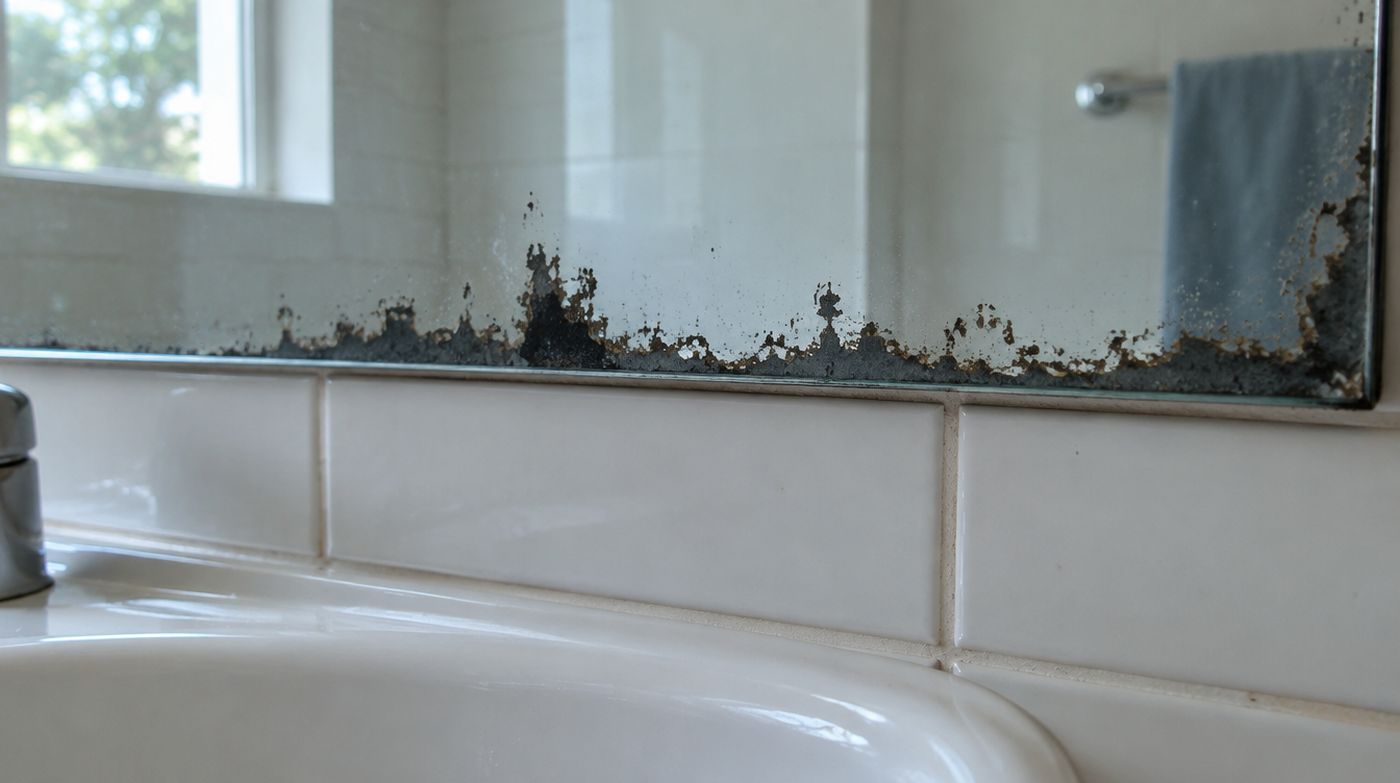
What bathroom mirrors bespoke to your sizes have to survive
Steam, condensation running down the face and pooling at the bottom edge, splash from a basin tap, cleaning sprays, and a window that nobody opens between November and March. Bathroom mirrors bespoke or otherwise all fail in the same two places, and neither of them is the front of the glass.
The silver on the back of a mirror is protected by a metallic layer and a paint system. Where that system is cut, which is every edge, or scratched, which is anywhere the back has been dragged across something, moisture gets to the silver and oxidises it. Our FAQ covers why that produces the black creep you see on old bathroom mirrors. What follows is what to do about it, which is a question of specification rather than explanation.
The edge detail that actually lasts
Three things in combination, and leaving any one of them out undoes the other two. First, the right glass: a modern copper-free silvered mirror with a high-build protective paint system intended for damp environments. Cheap mirror with a thin backing will blacken in a bathroom within a few years whatever you do to the edges, so the saving at order stage is borrowed against a replacement.
Second, a properly finished edge. A flat polished or well arrissed edge resists moisture better than a raw cut edge, because a raw cut carries microscopic chips and flakes along its length and every one of them wicks water in behind the backing. Edge sealant then goes on a sound edge rather than a damaged one.
Third, a fixing that keeps the edge out of standing water and lets the back of the panel dry. A mirror bonded flat to a cold external bathroom wall is the classic way to destroy a good mirror: the wall is the coldest surface in the room, moisture condenses behind the glass and has nowhere to go. Mount it off the wall on a ply pad or battens, or put it on an internal wall, and keep the adhesive in spaced vertical beads with the ends open.
Fixing a bathroom mirror to a tiled wall
You are drilling through a finished, expensive and effectively irreplaceable surface, usually one where the spare tiles went in the skip. Mark the position with masking tape so the bit cannot wander. Start with a diamond or spear point bit, low speed, hammer action off, and let it cut rather than pushing. Once through the tile, change to the right bit for whatever is behind. The plug goes into the substrate. The tile itself never carries any load.
Far better, if the bathroom is still being built, is to deal with it before tiling. A ply pad or a pair of battens fixed to the wall behind the tile line gives you something to screw into, which means the tile is drilled for clearance only and the weight goes into the structure. Tell your tiler where the mirror is going, with dimensions, before the adhesive comes out.
If the tiles are large-format porcelain, the mirror is small, and the wall is sound, dry and internal, consider not drilling at all. A bonded fixing with a bottom support is legitimate in that situation, and an undrilled tile is a tile you can still reuse when the room changes.
Cut-outs for lights, sockets and shaver points
This is the commonest reason a bathroom mirror has to be bespoke rather than bought. An aperture for a downlight, a hole for a shaver socket, a notch around a pull cord, or a panel cut to pass around an existing light fitting that the client likes and will not change.
Get the order of works right. The electrician first-fixes and then gives you final positions measured from two fixed references, normally the finished floor level and one named wall, not from the plasterboard that is about to be tiled over. We cut to those positions. Second fix follows. Doing it in the other order produces an aperture 20mm out of place, and an aperture cannot be moved.
What goes where in a bathroom is governed by the electrical zones in the wiring regulations, and that is the electrician's call rather than ours. What matters to the glass is that every internal cut edge needs the same treatment as the perimeter: arrissed or polished, then sealed, so the silvering at the hole is not left raw in the wettest room in the house. An unsealed cut-out blackens from the inside out and it looks worse than edge creep because it is right in the middle of the panel.
Apertures also weaken the panel. Mirror cracks from holes, particularly holes close to an edge or a corner, and usually during handling rather than in service. Keep cut-outs well in from the corners where you can, and tell us if the layout forces one close to an edge so we can allow for it.
Are demister pads worth it?
A demister pad is a thin heating element bonded to the back of the mirror that keeps the glass a couple of degrees above the dew point of the room, so it does not fog. They work. The question is whether your bathroom needs one.
Worth it: a mirror over a basin in a windowless or poorly ventilated bathroom, used by somebody who shaves immediately after a shower. Not worth it: a cloakroom, a bathroom with decent extraction, a mirror on the far side of the room from the shower, or a mirror nobody looks in while the room is still steamy. The pad also has to be decided before first fix, because it needs a fused connection, and it adds heat to the back of the panel, so the mirror has to be made for it.
Here is our honest position. We would rather sell you nothing and have you spend the money on extraction. If your fan is a 15-minute overrun unit wired to the light switch, ducted through 50mm of flexible hose with two kinks in it, that fan is where the problem is. Fix the ventilation and the fogging, the blackened edges, the peeling paint and the mouldy sealant all improve together. A demister pad treats one symptom of a room that is not clearing its moisture.
Where the mirror should go, and where it should not
Inside a shower enclosure is the request we turn down most often. It can be built, with the right glass and relentless sealing, and you will spend the rest of your life squeegeeing limescale off it. In a hard water area like most of London, that is not a hypothetical.
Directly behind a basin tap, where the bottom edge takes a splash every time anyone washes their hands, is the other one. Either raise the panel so the edge is clear of the splash zone, or accept that the bottom 10mm is going to need wiping dry regularly.
If a mirror runs down to a bath rim or a worktop, leave a gap. Do not let anybody seal the bottom edge into a continuous bead of silicone. The small amount of water that gets behind the panel has to be able to come out again, and a sealed bottom edge turns the back of the mirror into a sealed wet cavity. Seal the top and the sides if you want to keep splash out. Leave the bottom open.
Bespoke shapes: arches, radius corners and sloping ceilings
Bathroom mirrors bespoke to a shape rather than to a size are routine workshop work. An arched top, radiused corners, a circle or an oval, a panel scribed to the rake of a loft bathroom ceiling: all of it is normal. Shaped panels need a rigid template, not a piece of cardboard that has been standing in a damp bathroom for a week, and we would rather make the template ourselves on site than reverse engineer a soggy one.
It costs more, and the cost sits in the edge work rather than the cutting, because polishing a curve is several times slower than polishing the same length of straight edge. That is worth knowing before you ask for radius corners on all four corners of a large panel.
And the thing we will say even though it loses us work: in a small bathroom, a shaped mirror is often invisible once the room is finished. A mirror reads as a patch of light on the wall rather than as an object, so the arch you paid for disappears behind the reflection of the opposite wall. Tape the outline up, look at it for a week with the light on, and only then decide whether the curve is worth the money.
FAQ
Questions about bathroom mirrors bespoke
What kind of mirror should be used in a bathroom?
A copper-free silvered mirror with a high-build protective paint system made for damp environments, with every edge, including the edges of any cut-out, arrissed or polished and then sealed. Ordinary mirror put into a bathroom will blacken inward from the edges, usually within a few years. Thickness is typically 4mm for a small panel and 6mm for anything over about a square metre. It also matters how it is mounted: the back of the panel needs to be able to dry, so spaced adhesive beads or a ply pad, not a cold wall with glue across the whole back.
Can you cut a hole in a bathroom mirror for a light or a shaver socket?
Yes. Holes, apertures and notches are standard processing, and they are the usual reason a bathroom mirror has to be made to measure. Two conditions matter. The positions must come from the electrician after first fix, dimensioned from the finished floor and one named wall, because an aperture cannot be moved afterwards. And the cut edges inside the aperture need the same arrissing and sealing as the perimeter, or the silver will blacken outward from the hole. Keep apertures away from corners where the layout allows, since holes near a corner are where panels crack during handling.
Do I need a demister pad on a bespoke bathroom mirror?
Only in specific circumstances: a mirror over a basin in a bathroom with poor or no ventilation, used straight after a shower. If the room has working extraction, or the mirror is away from the shower, a pad is solving a problem you do not have. It needs a fused electrical connection, so it has to be designed in before first fix, and the mirror itself has to be specified to take the heat on its back. In most bathrooms we would rather the budget went on a properly ducted extractor fan, which cures the fogging and several other problems at once.
Send your mirror sizes
Tell us the size, where it is going and how it will be fixed. We will confirm the backing and edgework and quote in writing.