Buying from a mirror glass supplier: grades, tints and supply-only terms
This page is for anybody buying mirror as a product rather than as a finished job: fitters, kitchen and bedroom companies, interior designers, and homeowners who want to know what they are paying for.
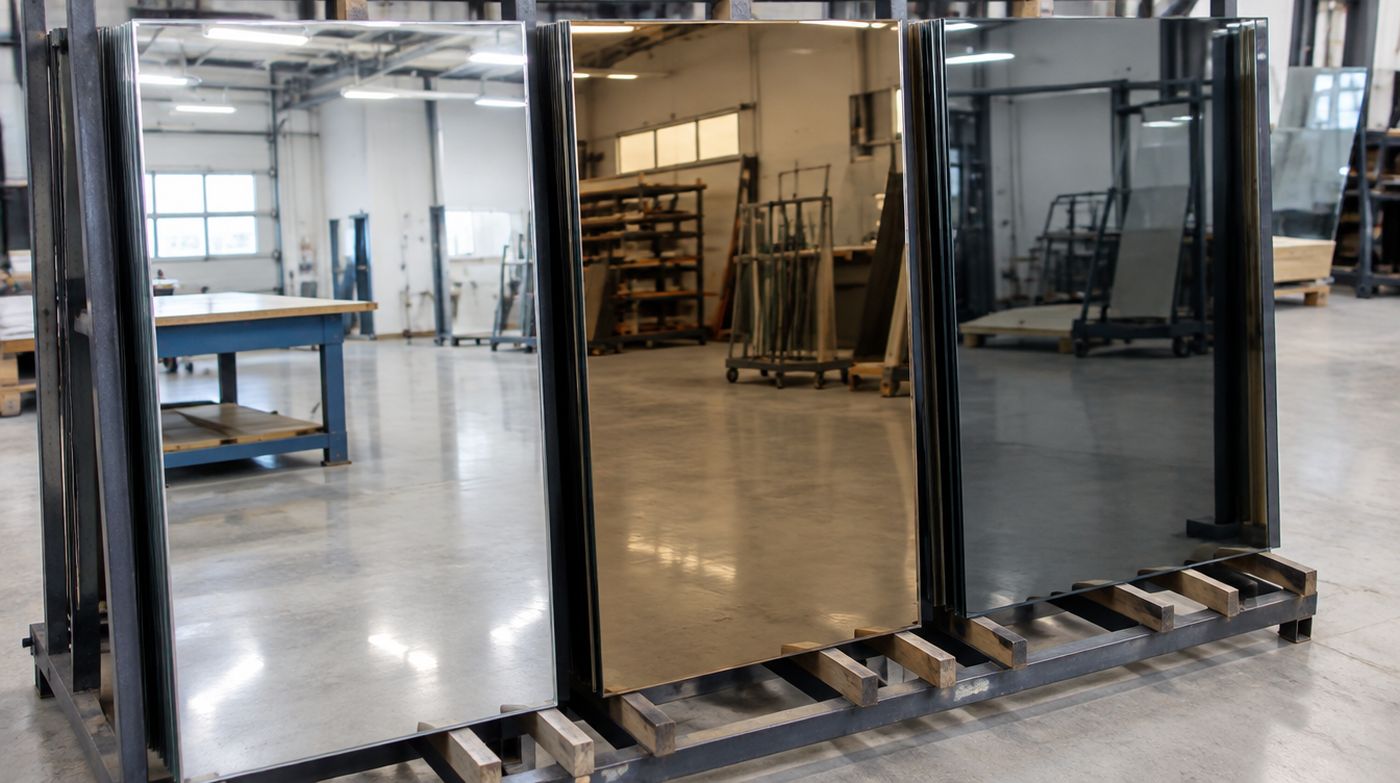
Questions a mirror glass supplier London wide should be able to answer
Choosing a mirror glass supplier London based or otherwise comes down to five questions, and none of them is the one most people ask first. Which backing system is on the glass. What dimensional tolerance the cut to size work is produced to. What the lead time is for edge work and processing, not just for cutting. Who carries the risk if a size is wrong. And whether a batch can be matched later.
Price is the sixth question and it only means something once you have the answers to the other five, because two quotes for a mirror panel can be for genuinely different products. The rest of this page is what sits behind each of those questions.
Backing: what is on the back, and why two different things share the name
How a mirror is silvered is covered on our home page. What differs between suppliers is not the silver, it is the protective system over it. Modern copper-free silvering with a multi-coat, lead-free paint system resists edge corrosion far better than older copper-backed product, and it is what should be specified anywhere near moisture. Cheaper mirror has a thinner paint build and a shorter life in any damp room.
Then there is safety backing, which is an entirely separate product: a film or applied coating bonded to the rear face whose job is to hold fragments together when the panel breaks. It does nothing for corrosion. The protective backing does nothing for fragment retention. Both are called backing, and a supplier who runs the two together in conversation is not a supplier to buy from.
So ask which backing system, by name, rather than asking whether it is good quality mirror. Every supplier in the country says yes to the second question.
How close to your size will the panel actually be?
Cut to size means cut to a tolerance, not cut to the micron. Plain cut work carries a wider tolerance than processed work with polished edges, because the edging process takes the panel to a dimension rather than leaving it at the cut. A serious supplier will tell you the figure they work to on each. One that will not is telling you that the tolerance is whatever the panel comes out at.
Squareness matters at least as much as the two dimensions, and it gets ignored. On a single panel in a frame nobody notices a millimetre out of square. On four butted panels across a gym or dressing room wall it shows up as a joint that tapers from top to bottom, and there is no way to correct it once the panels are made.
Who measured decides who pays. Supply only means the measurement risk sits with whoever took the measurements, and that has to be explicit rather than assumed. Send sizes in writing, get them confirmed in writing, and keep the confirmation. Every argument we have ever had about a panel started with a size agreed over the phone.
Yield: why your size can cost more than one slightly different
Mirror is cut from stock sheets, so the price of a panel is partly the price of what is left over. A size that nests efficiently into a sheet costs less per square metre than one that leaves an offcut too small to sell and too big to ignore. A panel just over half a sheet width is the classic example: you are paying for most of the rest.
Which means that if you have any flexibility, 20 or 30mm either way, say so when you ask for the price and ask whether a small change improves the yield. A good supplier will look. Very few will volunteer it, because volunteering it reduces the invoice.
The same logic applies to quantity. Four identical panels that cut cleanly out of one sheet cost considerably less than four different ones, which is worth knowing when you are speccing a run of wardrobe doors or a set of alcove panels in the same property.
Silver, bronze, grey, low iron and antique mirror
Where tinted and antiqued mirror works as a design choice is covered on our home page. The buying points are different. Bronze and grey mirror are made by silvering tinted float, so the colour is in the glass itself, not in the coating. That has two consequences: the tint deepens with thickness, so 6mm looks darker than 4mm from the same product range, and the polished edge shows the colour, which is sometimes exactly what you want and sometimes a surprise.
Antique and distressed mirror is a decorative finish, produced by chemically working the backing or by applied patterning. It is not consistent sheet to sheet and it cannot be matched later with any confidence. Low iron mirror is the opposite problem solved: it removes the faint green cast of standard float and costs more, and it earns its money in large panels and in rooms with a lot of white and daylight.
The practical rule for anything tinted or antiqued: order the whole job in one batch, including the panel you might want in the second bedroom next year. A tinted mirror bought in March and extended in September will not match, and nobody will be able to fix it for you.
Supply only: where the risk sits, and what we need on an order
We supply only, routinely, for fitters, kitchen and bedroom companies, shopfitters, landlords and interior designers, as well as fitting for retail customers. Whether we fit or supply is answered in our FAQ. What matters here is the terms.
You give sizes, you own sizes. We cut, process, edge, drill and back to your specification. You collect from Wembley or we deliver. Remakes caused by a measurement are chargeable, remakes caused by our processing are not, and we would rather have that written down at the start than discussed at the end. In return, trade pricing exists because there is no survey and no fitting labour in the job.
An order needs the finished sizes with the width identified, thickness, edge finish and which edges it applies to, the backing specification, every hole and cut-out dimensioned from two named edges, and the delivery or collection arrangement. If you want the detail on how to arrive at those numbers, it is on our mirrors cut to size page.
One piece of honesty for trade buyers. Trade buyers who measure well do better than retail on price. Trade buyers who measure badly do not, because two remakes on a kitchen's worth of splashback panels wipes out the margin on the whole order. If a job is awkward, ask us to survey it and charge the survey on.
Packing, collection and storing mirror on site
Panels go out edge-protected, interleaved and crated or framed according to size. Collection from the workshop in Wembley is fine for anything you can stand upright in your vehicle. For large panels, see our large wall mirrors page, because the route into the property usually decides the panel sizes before anything else does.
The part most people get wrong is storage. Mirror on site should stand on edge on timber bearers, leaning slightly back against a solid wall, in a dry room, off any heat source, and covered. Not flat. Not under a pile of plasterboard offcuts. Not in a room that is about to be plastered, because plaster dust and splashes attack the backing. Not against a radiator.
The commonest cause of a damaged panel is not the delivery. It is the three weeks the panel spends on site, leaning in a hallway in a house full of other trades, waiting for the room to be ready.
Paperwork a supplier should produce without being chased
A written order confirmation stating sizes, thickness, edge finish, backing and every cut-out. A price that separates glass, processing and delivery. And for safety backed product, the impact classification in writing, so the specifier can show what was supplied.
Be clear about what certification can and cannot tell you. There is no certificate that proves a mirror is a nice mirror. What you can get is a stated specification and a named backing system, and a supplier who puts that in writing is telling you something real about how they work. Treat the phrase high quality silver mirror, with nothing after it, as no information at all.
And do not pay a premium for mirror because it is described by its country of origin. Most European silvered float is produced on comparable lines to comparable standards, and the badge on the crate is not what determines whether your bathroom mirror survives. The things worth paying more for are the protective backing system and the quality of the edge work, and both of those you can ask about directly.
What we will not supply
Toughened mirror, because it does not exist in any form we would sell. Mirror used as a barrier, a balustrade infill or a protective screen, which is a BS 6180 question and needs glass that is designed for it. Plain unbacked mirror for a gym wall or for any large panel above a stair. Ordinary mirror for a wet room. And mirror behind a hob without looking at the position first.
Turning work away is cheaper than replacing it. If you want a mirror glass supplier London wide who will cut anything you ask for without comment, you will find one. You will also find out why the price was lower.
FAQ
Questions about mirror glass supplier london
What is the difference between copper and copper-free mirror?
Traditional mirror used a copper layer over the silver, sealed with paint. Copper-free silvering replaces that layer with a different protective chemistry and a multi-coat, lead-free paint system. The practical difference is corrosion resistance at the edges, which is where mirrors fail: copper-free product holds up far better in bathrooms, kitchens, utility rooms and any position with condensation behind the panel. It costs slightly more per square metre and lasts considerably longer in a damp room. For anything going into a wet environment, it is the specification to ask for by name.
Can you match an existing mirror?
Clear silvered mirror can usually be matched closely, because standard float and standard silvering are consistent products. Low iron can be matched if you know it is low iron. Tinted mirror, bronze and grey, varies between product ranges and between thicknesses, since the colour is in the glass, so a 6mm panel looks darker than a 4mm one from the same range. Antique and distressed mirror cannot be matched reliably at all, because the finish is deliberately irregular. For anything tinted or antiqued, order the whole job, including future panels, in one batch.
How should mirror be stored on site before it is fitted?
Standing on edge on timber bearers, leaning slightly back against a solid wall, in a dry room, covered, and away from radiators or other heat. Never flat, because panels stacked flat flex and get walked on, and never in a room that is being plastered, since plaster splashes and dust attack the backing paint. Keep the edge protection on until the day of fitting and check corners before you lift, because a chipped corner on an annealed panel is a stress point that will crack later rather than a cosmetic fault.
Send your mirror sizes
Tell us the size, where it is going and how it will be fixed. We will confirm the backing and edgework and quote in writing.