Large wall mirrors: the limits that decide the size you can have
Large wall mirrors are almost never limited by what can be cut. They are limited by what can be carried, what will go round your stairs, and what two people can hold without flexing it.
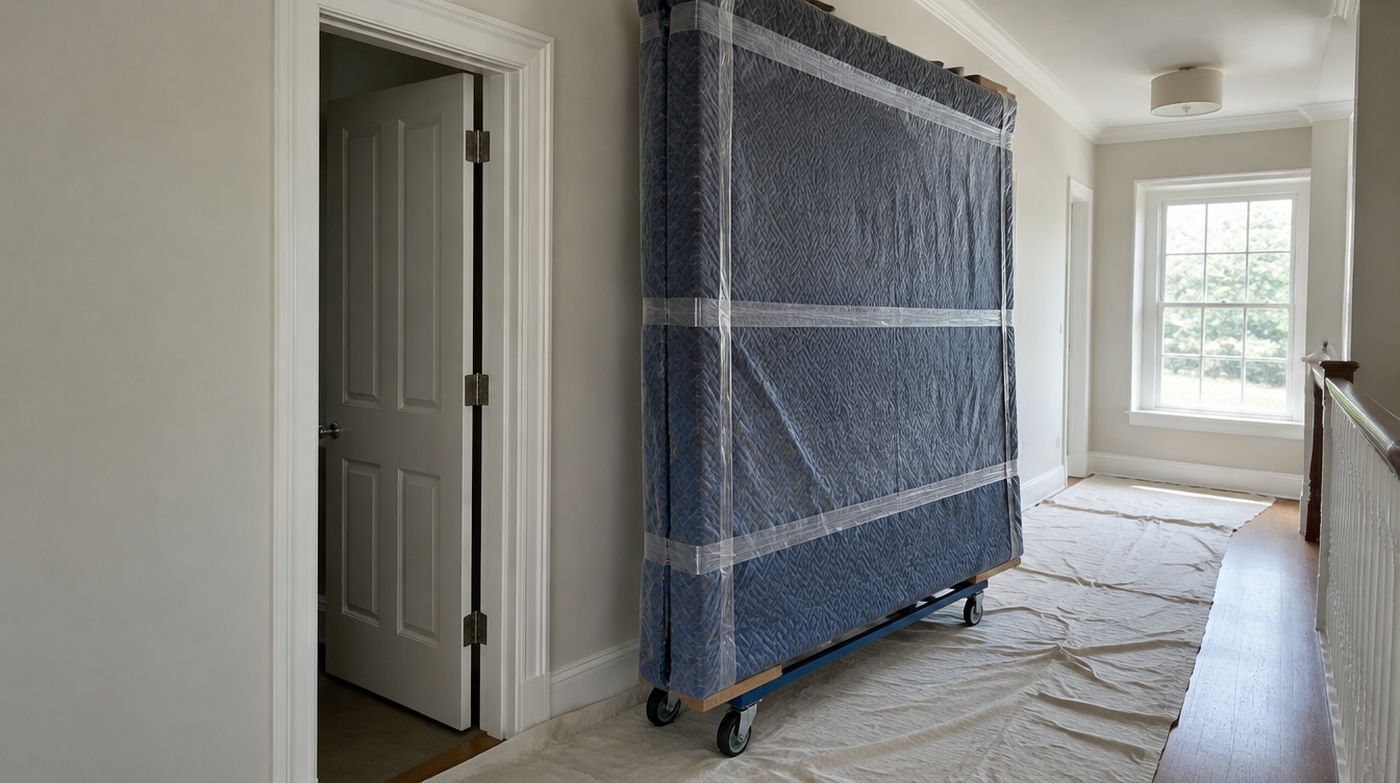
How large can a single mirror panel be?
Silvered float arrives at the workshop in stock sheets, the largest of which are a little over three metres long and a little over two metres high. In theory a single panel can be cut from almost all of one. In practice, large wall mirrors are limited long before that by three things: the machines that polish and process the edges, the weight of the finished panel, and whether anybody can get it from the van to the wall without bending it.
Weight is simple arithmetic. Glass runs at roughly 2.5kg per square metre for every millimetre of thickness, so 6mm mirror is about 15kg per square metre. A 2,400 by 1,200 panel is just under 3 square metres and around 43kg. A 3,000 by 2,000 panel is 6 square metres and about 90kg. Add a timber crate and that becomes a four-person lift on the flat, which is a different proposition on a staircase.
The other limit is flex. A large thin panel bends under its own weight while it is being carried, and bending is how mirror breaks: not with a bang, but from a point halfway along an edge, a day later. Thin glass in a big sheet also reads as distorted once it is on the wall, which our home page explains in detail. For a large panel the answer is 6mm, and the reason is flatness rather than strength.
Will it actually get into the room?
This is the measurement everybody forgets. Panels travel on edge, because that is the only way they can be carried without flexing, so the governing dimension is not the width of your doorway. It is the diagonal of every opening on the route, and the diagonal of the turn at the top of the stairs.
There is a free way to check. Cut a piece of 50mm timber batten to the longest dimension of the panel you want and carry it through the whole route, from the nearest legal parking space to the wall, including the front door, the hall, the stair, the half landing, the turn at the top and the bedroom door. If the batten will not go round, neither will the mirror, and unlike the batten the mirror cannot be angled past a newel post with a bit of persuasion.
London throws up the same obstacles over and over. Victorian terraces with a dog-leg stair and a solid newel at the bottom. Converted flats where the stair to the top floor is steeper and narrower than the one below it. Mansion blocks with a small lift car, a half landing on every flight and a managing agent who wants notice, insurance details and a delivery window outside working hours. Basement flats reached by external steps between railings. And new-build blocks where everything comes in through a goods lift that is booked out weeks ahead.
When the route defeats the panel, the alternative is window access with a suction lifter and sometimes a scaffold or a hoist. It is a real option and it is expensive, it needs the sashes out or the window removed, and in some boroughs it needs a pavement licence if the footway is obstructed. Nobody chooses it for the fun of it, which is why the batten test is worth ten minutes.
When to split into two or three panels
Splitting is not a compromise, it is usually the right answer. One panel looks seamless and that is its only advantage. Two or three panels get into the house, cost less to deliver and handle, are lighter and safer to fix, sit flatter on an imperfect wall, and mean that a knock during the next decade replaces one panel rather than the whole wall.
Our rule of thumb: split if any dimension is over about 2.4m, if the finished weight is over about 50kg, or if the route in has a turn. Those three cover almost every case we meet.
Splitting well matters. Equal panel widths, vertical joints, edges ground flat and arrissed so the joint is a hairline, a millimetre or two of gap for movement, and all panels cut from the same batch so the tint matches across the wall. The butt joint detail is covered on our gym mirrors page, where whole walls of butted panels are the norm.
Where you put the joint is a design decision with no cost attached. A joint landing on the centre line of a chimney breast or dead above a fireplace reads as a mistake. The same joint aligned with a window mullion, the edge of an alcove or the centre of a piece of furniture reads as deliberate. Decide it at quote stage, because panel widths cannot be changed afterwards.
A rectangular panel on a wall that is not square
At 600mm nobody cares whether the wall is plumb. At 2,400mm it is the whole job. Very few walls in a Victorian or Edwardian London house are plumb over two and a half metres, and almost no alcove is parallel, so a square panel set into a full-height opening will sit tight at one end and show a tapering gap at the other. The gap is usually a few millimetres and it is always on the side you look at first.
There are three ways out. Cut the panel to the taper, which means templating the opening properly and accepting that the mirror then fits that one position and nowhere else. Design a deliberate shadow gap, 8 to 10mm all round, so there is no tight line anywhere and the eye reads the gap as intentional. Or fit the panel square and cover the discrepancy with a bead or a packer, which is the cheapest answer and looks like what it is.
We would choose the shadow gap most of the time, and we would say so before quoting for a template. A tapered cut on a large panel costs real money, it has to be right first time, and in a room where the ceiling line is also off, the effort buys you a tight fit that still looks wrong because the ceiling is sloping. A consistent deliberate gap is more forgiving and it survives the next time somebody skims the wall.
Handling a large mirror on site
Panels are carried upright, on edge, with the face held slightly off vertical so it leans into the carriers. Two people minimum above roughly 25kg, four above 50kg. Suction cups on the face, gloves, and sleeves, because the edge of a large panel will go through a shirt. Set down on timber bearers, never straight onto a hard floor and never flat.
Corners are the weak point. A chipped corner on an annealed panel is not cosmetic damage, it is a stress point, and a panel that has been nicked on a corner during delivery will often crack weeks later from exactly there. That is why panels are crated or edge-protected for transport and why we would rather deliver than let a large one go out in a customer's car.
If you are collecting a large mirror yourself, bring a second person and a vehicle the panel can stand upright in. Mirror laid flat in the back of an estate car, flexing over every speed hump between Wembley and home, is how a forty minute saving turns into a new mirror.
Delivery and parking: the London part
A two and a half metre panel cannot be walked 200 metres from a parking space in the rain, so where the van can legally stop is part of the specification. Controlled parking zones, residents-only bays with no loading, red routes with no stopping at all, timed loading bays that free up at ten, estate access barriers, and concierge systems that will not let a delivery past without prior notice all change how a large panel reaches your wall.
What we need to know at quote stage is short: which floor, lift or stairs, where the nearest legal unloading point is, and whether the building restricts delivery hours. If you are on a street with permit bays and no loading, say so then. Suspending a bay through the council costs money and needs days of notice. Discovering the problem on the morning of the delivery costs you the slot.
What not to pay extra for on large wall mirrors
A bevel, by default. At small sizes a bevel is a quiet detail. On a two metre panel the bevel band becomes a strong decorative statement that will date, it narrows the usable reflective area, and on butted panels two bevels meeting produce a dark line down the joint. Buy it because you want that look, not because it is on the options list.
A frame, if the mirror is fixed to the wall. A frame on a wall-fixed panel does nothing structurally. It adds weight, cost and another thing to clean behind, and it makes the panel harder to get up the stairs.
And toughening, which cannot be done to a mirror at all: the reason is in our FAQ. If anybody quotes you toughened mirror for a large panel, that quote needs explaining before anything else on it is believed.
The one place we will push you to spend more is low iron glass. Standard mirror has a faint green cast from the iron in the float glass, and because you are looking at the reflection through the thickness twice, the cast is cumulative. At small sizes nobody notices. On large wall mirrors in a well-lit room it is visible, particularly against white walls, and that is the size at which the extra cost earns itself.
FAQ
Questions about large wall mirrors
What is the largest size a mirror can be made?
Mirror is silvered on standard float sheets, the biggest of which are a little over three metres by two. A single panel can be cut close to that, but it is rarely practical. A 3,000 by 2,000 panel in 6mm weighs around 90kg, needs four people, and will not turn on a domestic staircase. The real limit on almost every job is the route into the room rather than the glass itself, which is why most large mirror walls are made from two or three matched panels butted together rather than one sheet.
How much does a large wall mirror weigh?
Glass weighs roughly 2.5kg per square metre for each millimetre of thickness, so 4mm mirror is about 10kg per square metre and 6mm is about 15kg. That makes a 2,000 by 1,000 panel in 6mm around 30kg, and a 2,400 by 1,200 panel around 43kg. Safety backing and packaging add a little more. Those figures matter twice: once for the lift up the stairs, and once for the fixing, because the wall and its fixings have to carry that load in shear for decades, not just on the day.
Should a large mirror be one panel or two?
Two, in most London houses. One panel is seamless and that is its only advantage. Splitting makes the glass liftable, gets it round the stairs, lowers the delivery cost, reduces the risk of a single expensive breakage, and allows the panels to sit flatter on a wall that is not perfectly true. We would split anything over about 2.4m in one direction, over about 50kg, or where the route in has a turn. Cut the panels from one batch so the tint matches, and place the joint deliberately.
Send your mirror sizes
Tell us the size, where it is going and how it will be fixed. We will confirm the backing and edgework and quote in writing.