Made to measure mirrors
How to measure for a mirror, which backing and edge you need, and the specification mistakes that cost people their mirror a few years later.
What made to measure mirrors actually involve
Made to measure mirrors are cut from a sheet of silvered float glass to the exact size of the opening, wall or alcove they are going into, with the edges worked and the back specified for the room. There is no trimming afterwards. A mirror cannot be shaved down on site the way a piece of timber can, so the dimensions we are given are the dimensions you live with. That is why most of the work in a bespoke mirror job happens before any glass is cut, and why we survey rather than taking numbers over the phone on anything shaped or anything large.
We make mirrors to size in our own glass workshop in Wembley. Panels are cut from stock sheet, edge worked on our machines, drilled where fixings or lights pass through, backed with safety film where it is needed, and delivered on our own vehicles with our own fitters. Nothing is ordered in cut and nothing is handed between companies, which matters because every extra handling of a mirror is another chance to scratch the back or nick an edge.
How do you measure an alcove for a mirror?
Measure the width at three heights, not one. Take it at the bottom just above the skirting, at the middle, and at the top. Then measure the height at the left, the centre and the right. You will almost certainly get six different numbers. In a Victorian chimney breast recess a variation of 10mm to 20mm across a two metre height is completely normal, because the brickwork was never plumb and the plaster has been patched by four generations of decorator.
Use the smallest width and the smallest height. If the recess is 902mm at the bottom and 894mm at the top, your mirror cannot be wider than 894mm or it will not go in. Then deduct a working tolerance on top of that, typically 3mm to 5mm in total across each dimension, so the panel can be offered up and manoeuvred into place without being forced. Forcing a mirror into a tight recess is how a panel cracks in the last ten seconds of a job.
Two other things people forget. Check whether the skirting board is being kept, because a mirror that drops behind the skirting needs to be shorter than one that sits on top of it, and a panel resting on skirting needs the skirting to be level. And check the depth of the recess against any pipe boxing, picture rail return or electrical conduit, because a 900mm wide mirror is no use if the last 40mm of the wall is occupied by a radiator pipe.
How do you template a recess that is not rectangular?
You make a physical template and we cut to it. Hardboard, 3mm plywood or heavy card, cut slightly undersize, offered into the opening, then scribed with a block and a pencil to pick up the exact line of the walls. Cut, offer it up again, adjust, and keep going until the template drops in with an even gap all round. It takes half an hour and it eliminates the guesswork completely.
Mark the template clearly. Write TOP at the top, write FRONT on the face that will look out into the room, and note which way up it was taken. A template handed over the wrong way round produces a mirror that is a perfect mirror image of what you need, which with a symmetrical panel is harmless and with an asymmetrical alcove is a write-off. Cut the template to the finished glass size, including your tolerance, so there is no ambiguity about who deducted what.
If that sounds like more than you want to take on, say so. Our site survey is free anywhere in London, we make the template ourselves, and a resurvey costs nothing whereas a remake costs the full price of the glass. There is no prize for templating your own shaped mirror.
What thickness should a made to measure mirror be?
For wall mirrors cut to size, 4mm and 6mm cover almost everything. 4mm is right for small and medium panels, anything going into a frame, cupboard door inserts, cloakroom mirrors and panels under roughly 600mm by 600mm. 6mm is right for large wall mirrors, full height alcove panels, anything over about a metre in either direction, and every gym mirror without exception.
The reason is stiffness rather than strength. A thin panel in a large size bends, and bending in a mirror is visible twice because the light passes through the glass twice. 6mm is around three times as resistant to bending as 4mm for the same panel size, which is the difference between a reflection that stays straight and a reflection that stretches as you walk past it. The extra cost is small. The extra weight is real and changes how the panel is fixed and carried.
Above roughly 2400mm by 1200mm we start suggesting two or three butted panels rather than one heroic sheet. A single enormous mirror sounds better until it has to come through a London front door, round a half landing and up a stairwell. Two panels with a clean butt joint look deliberate. One cracked panel looks like a bad decision.
Polished, bevelled or arrissed: which edge do you need?
Decide the edge by whether you will see it. A mirror that disappears behind a frame or beading only needs the edge taken off for safe handling, and paying for a flat polish on an edge nobody will ever see is money thrown away. A mirror that sits in an alcove with its edges on show needs a proper flat polish, square and bright, because a ground edge left matt reads as unfinished the moment light catches it.
A bevel does something different and it is worth understanding before you order one. Grinding the face back at an angle round the perimeter creates a band that refracts light rather than reflecting it straight, so the edge throws a faint prismatic line and picks up a highlight as you move. It reads traditional, it suits a panelled room, a period fireplace wall or a dining room, and it looks wrong on a gym wall or in a minimal bathroom.
Remember that a bevel eats into the usable reflective face. A 25mm bevel on a 600mm wide panel removes 50mm of flat mirror across the width and you will notice the image breaking at the edges when you stand close. For full length mirrors where you need an honest view of yourself, a polished flat edge is the better specification. We will tell you if we think a bevel is going to fight the room.
Drilled holes, notches and cutouts
Mirror is drilled and notched after silvering, which means every hole and every cutout is a break in the protective backing as well as in the glass. We seal round holes where moisture is a risk, we keep holes a sensible distance in from the edges and from each other, and we use cover caps rather than leaving a raw drilled edge on display. Holes need to be in the specification from the start, because drilling a finished panel that has already been delivered is not a job to do on a bathroom floor.
Cutouts for shaver sockets, concealed lighting, switch plates, tap runs and mirror lights are all routine. What is not routine is adding one later. Get the electrician to mark exact centres before we cut, in writing, measured from a fixed reference such as the finished floor or a corner rather than from the edge of the tiles.
Gym mirrors: how to specify and install them properly
Gym mirrors live harder lives than any other mirror in a house. They get sweated on, wiped with disinfectant, knocked by bars and dumbbells, and they are usually the largest glass in the building. Everything about the specification follows from that. 6mm glass, a higher durability backing, safety backing film on every panel, polished edges on anything exposed, and a mechanical installation that does not rely on adhesive alone.
Height matters more than people expect. Leave a kicker gap of 100mm to 150mm between the floor and the bottom of the glass. That gap does three jobs: it keeps the vulnerable bottom edge away from mops, vacuum heads and dropped plates; it gives you somewhere to hide the support batten or J-channel; and it means spilt water and floor cleaner never sit against the edge. If you need to see your feet, a mirror starting at 150mm still shows them from two metres away.
For the top, 1800mm off the floor is enough to see a standing person. If anybody will be doing overhead pressing, snatches or anything on a box, take the glass to 2000mm or above so the bar stays in frame. A 150mm kicker with glass to 2000mm means panels 1850mm tall, which is a standard, sensible size to make and to carry.
For a run of butted panels, order them all the same width, from the same batch where we can, so the colour and the reflected tone match along the wall. Silvered float glass varies very slightly between production runs and you only notice it when two panels meet. Polish every vertical edge, butt the panels with a 1mm to 2mm gap rather than tight, and set them out so the joints fall somewhere sensible rather than straight down the middle of where you stand.
Fix gym mirrors to a backing sheet, not to plasterboard. We screw 12mm or 18mm ply to the studs or to the masonry, make sure the plane is flat, then bond the mirror to the ply with a bottom support carrying the weight. In a garage or a loft this also deals with the fact that the wall underneath is rarely flat and sometimes slightly damp. It costs more than sticking glass to the wall and it is the only version of this job we are willing to guarantee.
Bathroom mirrors in rooms with no window
Bespoke bathroom mirrors in internal bathrooms are the hardest condition a mirror has to survive in a house. There is no ventilation except an extractor somebody turns off, the air is saturated after every shower, and condensation runs down the face of the glass and collects at the bottom edge. That is exactly the mechanism that destroys the backing.
Three things fix it. First, a higher corrosion resistance mirror with a copper-free backing. Second, keep the glass off the wall. We fit bathroom panels on standoffs or on a batten so there is a few millimetres of air behind, which means water cannot pool between glass and tile and the back can dry out. A mirror bonded flat onto a wet wall has nowhere to go. Third, leave the bottom edge open.
That last point is counter-intuitive, so it is worth spelling out. People silicone all four edges to make it look neat, which traps every drop of condensation that gets behind the panel and holds it against the backing permanently. Seal the top and the two sides if you want to, and leave the bottom unsealed so water can drain out and air can move. A mirror that can dry will outlive a mirror that has been sealed into a damp pocket.
Set the bottom edge above the splash zone behind a basin, with a shadow gap rather than sitting the glass down onto the tiles or onto the back of the basin itself. Demister pads are genuinely useful in a windowless shower room and genuinely pointless in a bathroom with a working extractor and an opening window. We will tell you which one you have.
Antique, bronze, grey and smoked mirror: where they work
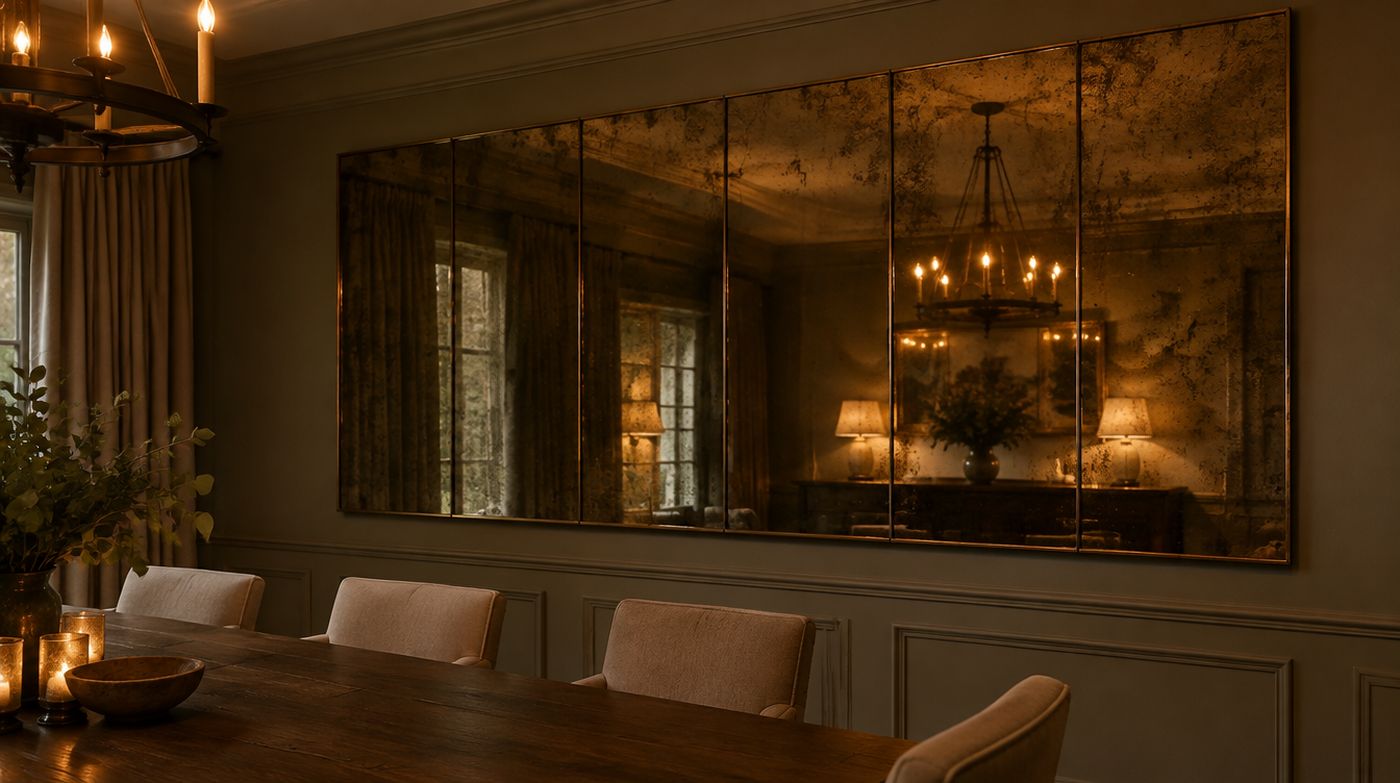
Tinted and antique mirror solve a problem clear mirror creates. Clear mirror is an honest, bright, sharp reflection, which is what you want in a dressing area and a gym and exactly what you do not want facing a kitchen full of appliances. Bronze and grey mirror lower the brightness and warm or cool the image, so the reflection sits back into the room instead of jumping forward. Antique and distressed mirror goes further and scatters the image, so you read texture and light rather than a second copy of the room.
Where that reads well: a splashback run behind a hob, where antique mirror bounces light without showing every pan; a panelled alcove or a chimney breast in a period room; a dark dining room where clear mirror would look like a hole punched in the wall; the back of a dresser or a bar. Bronze works particularly well with brass ironmongery and warm timber, grey with black metal and cooler schemes.
Where it does not work: anywhere somebody needs to see themselves accurately. Never specify antique mirror in a gym, over a shaving basin, in a dressing room or on a wardrobe door. You will not be able to use it. Also worth knowing that distressed and antiqued finishes often have a more vulnerable back than plain silvered mirror, so they belong on dry walls rather than in a shower room.
Mirror adhesive, escape routes and fire
There is a point about adhesive that almost nobody raises and it matters in flats. Many mirror adhesives and construction adhesives are solvent-based or otherwise combustible, and a protected escape route such as a common stairwell or a shared corridor in a block has requirements about the reaction to fire of the materials in it. Bonding a large mirror into a communal stairwell with a bead of the wrong adhesive can create a problem a building manager or fire risk assessor will object to, quite reasonably.
The straightforward answer in any communal area, escape corridor or protected stair is mechanical fixing. Clips, a track, standoffs or a cleat on a non-combustible fixing, with no reliance on adhesive at all. It is also a sensible instinct inside a flat where the mirror is in the hallway that leads to the front door. If you are fitting in a managed block, ask the managing agent what they require before anybody orders glass.
What we need from you to quote a made to measure mirror
- Finished sizes, or a note that the opening is out of square and needs surveying
- What the wall is made of: solid plaster, lath and plaster, plasterboard on dabs, metal stud, blockwork, tiled
- Thickness, or just the use and the size and we will specify it
- Edge finish, and whether the edges will be visible or hidden
- Any holes, notches or cutouts with dimensioned centres
- Whether the room is wet, humid, unventilated or a gym
- Access: front door width, stair turns, lift, loft hatch, parking
Give us those and you will get a written fixed quotation rather than a range. Mirror glass supply across London runs out of the Wembley workshop, we are strongest in north, west and central London, and the survey is free. The number is 020 4634 6045, Monday to Friday, 8am to 5pm.
FAQ
Questions we get asked
Can mirror be cut to any size?
Within reason, yes. Mirror is cut like any flat glass, so the limits are the sheet size, the weight and whether the finished panel can physically reach the room. A 6mm mirror is about 15kg per square metre, so a gym wall panel two metres by one is around 30kg before you add handling. We check the route at the template visit.
Why do bathroom mirrors go black around the edges?
Because moisture has reached the silvering at the edge, or because the wrong adhesive was used behind it. Acetic silicone, the kind that smells of vinegar, attacks the backing and causes the same damage from the back rather than the edge. Both are avoidable with the right specification and the right adhesive, and neither can be repaired once it has started.
Can you toughen a mirror?
No. The silvering and its protective layers cannot survive the furnace. This matters because people sometimes want mirror in a position where safety glass is legally required, and that is not something a mirror can satisfy. Safety backing film holds a broken mirror together but does not make it safety glass to BS 6206.
What is the difference between polished and bevelled edges?
A polished edge is flat and smooth, finished so it is safe and clean to look at. A bevel is an angled facet ground around the face of the mirror, typically 20mm or 25mm wide, which catches the light and reads as more traditional. A bevel costs more and takes longer, and it is wasted money if the edge will be hidden behind a frame or a fixing.
Do you fit, or supply only?
Both. We fit across London with the correct adhesive and fixings, which on a large mirror is worth having done properly, because a panel that drops is dangerous and the wall usually comes with it. For trade and DIY, collection from Wembley is straightforward.
Can I have a mirror splashback behind my hob?
Sometimes, and we will give you an honest answer rather than just taking the order. Mirror cannot be toughened, so it does not have the thermal resilience of a toughened glass splashback, and the position behind a hob is the most demanding in the kitchen. Along a worktop away from direct heat it is usually fine. Directly behind a gas burner it often is not.
Send your mirror sizes
Tell us the size, where it is going and how it will be fixed. We will confirm the backing and edgework and quote in writing.