Alcove & wall mirrors
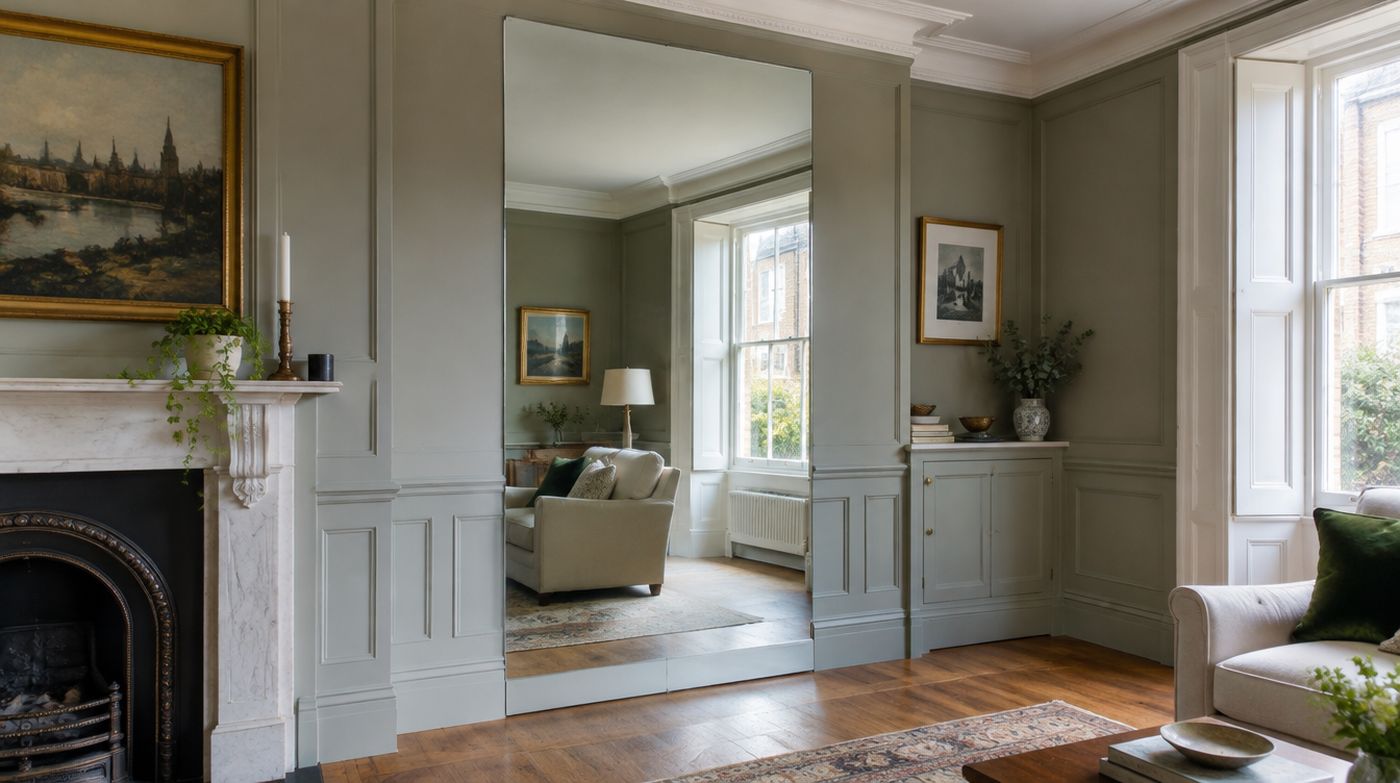
Mirror cut to fill a chimney breast alcove, a hallway wall or a dining room return, with edges polished and the panel fixed flush.
- Cut to the alcove
- Polished or bevelled
- Flush fixed or standoff
Mirror glass · Wembley HA9
Mirror glass cut to your sizes with polished or bevelled edges, safety backed where it needs to be. Alcoves, gyms, wardrobe doors, bathrooms and splashbacks. Made in Wembley, fitted or collected.
No forms. Call the workshop, or email and we will come back the same working day.
What we do
Mirror is just glass with a silvered back, but the backing is what makes it awkward. It cannot be toughened, it corrodes if the edge gets wet, and in a bathroom the specification matters more than anywhere else.
Mirror cut to fill a chimney breast alcove, a hallway wall or a dining room return, with edges polished and the panel fixed flush.
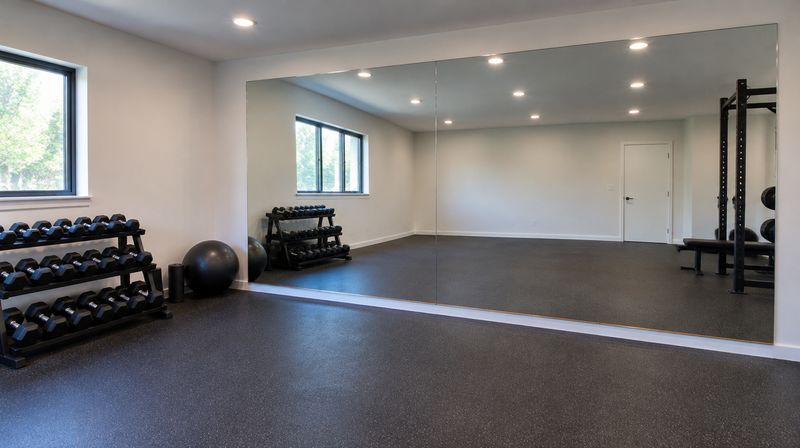
Large mirror walls for home gyms and studios, safety backed so a knocked panel holds together rather than falling.
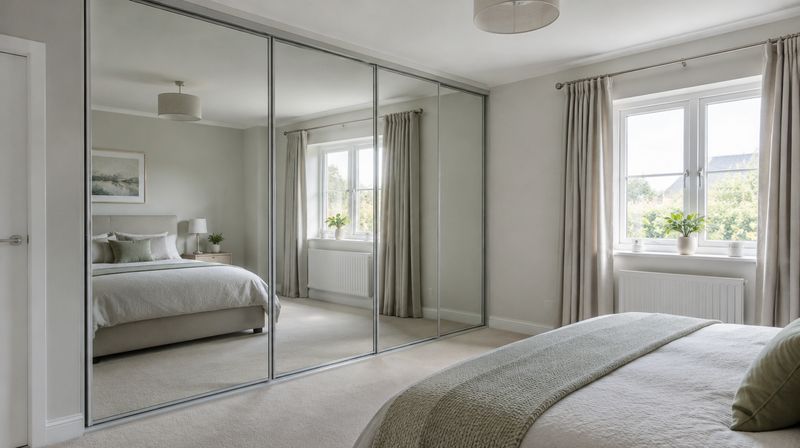
Mirror panels cut for wardrobe doors and sliding fronts, with cut-outs where handles and tracks require them.
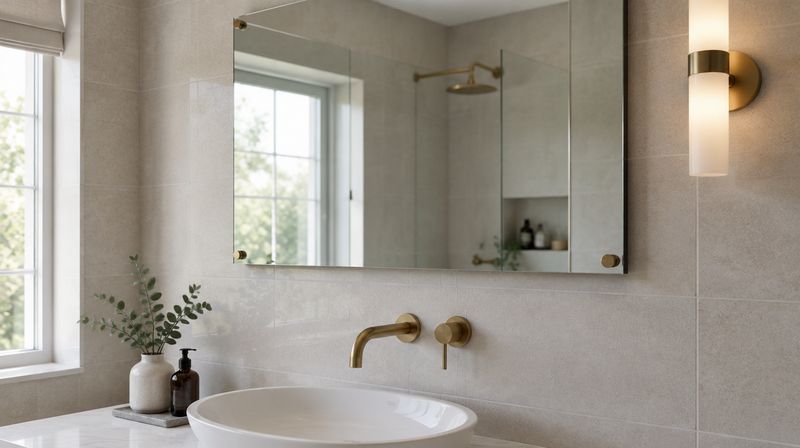
Mirror made for a wet environment, with the edges sealed properly. Ordinary mirror in a bathroom blackens at the edges within a few years.
Tinted and antiqued mirror glass where a clear silver mirror would be too bright or too literal.
Mirrored glass behind a worktop or hob. Toughened mirror is not possible, so the position has to be assessed before it is specified.
The work
Illustrative images of the systems described above. Specification and finish are confirmed in writing with your quotation.
Mirror is float glass with a coating on the back, and almost everything that goes wrong with it comes from that one fact. People ordering mirrors cut to size in London usually concentrate on the two figures that are easy to picture, the dimensions and the price per square metre. The things that actually decide whether the panel still looks right in ten years are the thickness, the edgework, the grade of the backing and the way it is fixed to the wall. None of those appear on a one line quote, so nobody argues about them until the mirror is already on the wall.
We cut, grind and polish mirror in our own workshop in Wembley, so the panel that arrives at your house has been measured, cut, edged and inspected by the same firm that fits it. That matters more with mirror than with ordinary glass, because a mirror puts its own faults on display. A pane of clear glass with a slight wave in it still looks like a window. A mirror with a slight wave in it looks like a funfair.
A mirror starts as a sheet of ordinary float glass. It is washed, polished with cerium oxide, chemically sensitised, and then silver is deposited onto the back out of solution. That silver film is the reflection and it is a fraction of a micron thick. On its own it would tarnish in weeks, so a second metallic layer goes on top, historically copper, now more often a copper-free passivation chemistry. Over that go two or three coats of protective backing paint.
So the back of a mirror is a stack: glass, silver, a protective metal or passivation layer, then paint. The paint is the only thing standing between the silver and the air. Scratch it with a screwdriver while you are fitting, or let water sit against it, and the silver underneath will start to go. That is why a mirror which has been dropped flat and looks fine can develop a grey bloom six months later.
Mirrors for internal use are covered by BS EN 1036, which includes requirements for the silvering and for resistance to corrosion. Above that baseline, manufacturers sell higher durability mirror with copper-free backing and heavier paint systems, tested in salt spray and humidity cabinets. Those grades genuinely last longer where there is moisture or cleaning chemical in the air.
Where they are worth the money is a bathroom, a shower room, a utility, a kitchen splashback run and a home gym, because gyms get wiped down with disinfectant every day. Where they are not worth the money is a dry hallway, a bedroom, a living room alcove or a home office. If your wall never gets wet, standard grade silvered float mirror is the right buy and the premium grade will look identical for the whole of your life in the house.
A mirror on a dry internal wall does not need an upgraded backing. Buy the right thickness and the right edge instead. That is where the money shows.
Float glass is flat, but it is not perfectly flat, and it bends. Hang a large thin panel on a wall that is not dead flat and the glass will take up the shape of the wall, or bow in the middle between its fixings. In a window you would never notice. In a mirror you notice immediately, because the light travels in through the glass and back out again, so any curvature in the surface is applied to the image twice over. A bow you could not detect with a straight edge turns a reflected door frame into a banana.
Thickness is the fix, because stiffness rises very steeply with thickness. Going from 4mm to 6mm roughly triples the panel’s resistance to bending. Our rule of thumb is that anything over about a metre in either direction, anything a person will stand in front of at full height, and anything in a gym gets quoted in 6mm. Below about 600mm square, 4mm is perfectly honest and we will not try to sell you 6mm for a cloakroom panel.
The other half of the fix is the wall. A 6mm panel bonded flat onto a bowed plaster wall will still be pulled out of true. On old plaster we either batten and ply the area first to get a flat plane, or we pack and mechanically fix so the glass is allowed to stay straight while the wall stays crooked.
Weight decides this, and the weight is easy to work out. Glass runs at about 2.5kg per square metre for every millimetre of thickness, so 4mm mirror is roughly 10kg per square metre and 6mm is roughly 15kg. A 2000mm by 1000mm panel in 6mm is therefore about 30kg of glass hanging off your wall with nothing underneath it. That is a weight nobody would expect to hold up with sticky pads, and yet that is what a lot of mirror adhesive is being asked to do.
Most new-build flats and a great many refurbished London houses have plasterboard stuck to the masonry on dabs of adhesive, with voids behind. Bond a heavy mirror to that and the adhesive will probably hold. The question is whether the board will. You have created a situation where 30kg is hanging on a 12.5mm sheet of gypsum that is itself only held on by blobs, and the load is trying to peel it off the wall.
When these fail, the mirror does not come away from the board. A patch of plasterboard comes off the wall with the mirror still firmly attached, which is both more expensive and more dangerous. The fix is to find the structure behind, fix a timber or ply backing through the board into the masonry with the fixing packed so you are not crushing the board, then bond to that. A survey takes five minutes and tells us which wall we are dealing with by knocking on it.
A mirror shows you whatever is opposite it, which sounds obvious and is routinely forgotten. Facing a window it doubles the daylight and gives you a second view of the garden. Facing a blank wall it gives you twice as much blank wall. In a narrow London hallway the mirror wants to go on the long return wall rather than at the far end, because a mirror at the end of a corridor reads as a closed door and a mirror along the side makes the corridor feel twice as wide.
Full height in an alcove is the one placement that nearly always works. A mirror filling a chimney breast recess from skirting to picture rail reads as an opening into another room rather than as an object hung on the wall, because there is no frame and no visible edge to tell your eye it is a surface. The same panel with a 100mm margin of plaster round it reads as a mirror and nothing more.
Where it goes wrong: opposite a cluttered kitchen worktop, where you simply get two bin lids and two kettles. Directly opposite a bedroom door, where you catch movement out of the corner of your eye all evening. And across from a television, which is worse than it sounds. If the only wall available faces something you would rather not look at twice, tinted or antique mirror is a better choice than clear, because it softens the image instead of repeating it sharply.
Cleaning it. Somebody sprays glass cleaner straight at the mirror, the liquid runs down the face, and it collects along the bottom edge where the glass meets the wall. Mirror edges are cut and ground, which means the layered backing is exposed on the arris. Fluid sitting there wicks between the paint and the silver and lifts it, and a year later you have a dark creeping fringe 10mm up from the bottom that no amount of polishing will remove.
Spray the cloth, not the mirror. Wipe, then run a dry cloth along the bottom edge. Avoid anything with ammonia or vinegar in it. In a bathroom, wipe the bottom edge dry after a shower for the same reason. Those three habits are the difference between a mirror that lasts decades and one that is edge-blackened in a couple of years, and they cost nothing.
If you have sizes already, we can price from them. If the recess is out of square, or you are not sure what the wall is made of, our survey across London is free and a written fixed quotation follows it. Call the workshop on 020 4634 6045 between 8am and 5pm, Monday to Friday.
How it works
Four stages, and we tell you where you are at each one.
Send sizes, or we template. Alcoves are almost never square and a mirror shows a tapering gap more cruelly than any other material.
Mirror type, edgework, backing, fixing method and any cut-outs, confirmed in writing before cutting.
Cut, edge worked and backed in our Wembley workshop. Bevelling is a separate process and adds a little to the lead time.
Fitted by our own teams with the correct neutral adhesive, or collected from HA9.
Specification
Every quote states the glass build, the standards it is made to and the hardware. If a quote you are comparing does not, that is worth asking about.
Mirror is cut, polished and bevelled on Atlas Road in Wembley, where the backing is handled carefully enough to last.
| Item | Specification |
|---|---|
| Thicknesses | 4mm for most wall and alcove mirrors, 6mm for large panels, gym walls and anywhere the mirror is handled. Thicker mirror stays flatter and distorts less. |
| Edgework | Arrissed where the edge is hidden, ground or polished where it is visible, bevelled where you want the light catch. A 20mm or 25mm bevel is the usual choice. |
| Safety backing | A film laminated to the back so a broken mirror holds together. Essential for gyms, wardrobe doors, stairwells and anywhere at height or where people move quickly. |
| Mirror cannot be toughened | The silvering and its protective coatings do not survive a toughening furnace. Where safety glass is a legal requirement, a mirror is usually not the right product and we will say so. |
| Bathrooms | Edges must be sealed and the mirror must not be bonded with ordinary acetic silicone, which attacks the backing. Edge corrosion, the black creep inwards from the edge, is almost always one of those two failures. |
| Fixing | Bonded with a neutral cure mirror adhesive, or mechanically fixed on standoffs or clips. Adhesive and backing have to be compatible or the mirror will blacken where the glue sits. |
FAQ
Within reason, yes. Mirror is cut like any flat glass, so the limits are the sheet size, the weight and whether the finished panel can physically reach the room. A 6mm mirror is about 15kg per square metre, so a gym wall panel two metres by one is around 30kg before you add handling. We check the route at the template visit.
Because moisture has reached the silvering at the edge, or because the wrong adhesive was used behind it. Acetic silicone, the kind that smells of vinegar, attacks the backing and causes the same damage from the back rather than the edge. Both are avoidable with the right specification and the right adhesive, and neither can be repaired once it has started.
No. The silvering and its protective layers cannot survive the furnace. This matters because people sometimes want mirror in a position where safety glass is legally required, and that is not something a mirror can satisfy. Safety backing film holds a broken mirror together but does not make it safety glass to BS 6206.
A polished edge is flat and smooth, finished so it is safe and clean to look at. A bevel is an angled facet ground around the face of the mirror, typically 20mm or 25mm wide, which catches the light and reads as more traditional. A bevel costs more and takes longer, and it is wasted money if the edge will be hidden behind a frame or a fixing.
Both. We fit across London with the correct adhesive and fixings, which on a large mirror is worth having done properly, because a panel that drops is dangerous and the wall usually comes with it. For trade and DIY, collection from Wembley is straightforward.
Sometimes, and we will give you an honest answer rather than just taking the order. Mirror cannot be toughened, so it does not have the thermal resilience of a toughened glass splashback, and the position behind a hob is the most demanding in the kitchen. Along a worktop away from direct heat it is usually fine. Directly behind a gas burner it often is not.
In detail
A page on each part of what we do, written to answer the question properly rather than to sell.
How to measure for a mirror, which backing and edge you need, and the specification mistakes that cost people their mirror a few years later.
Mirror is cut once, to the number you give us. This page is about the part you control: the measurement, the deduction, the specification, and the handful of things that cannot be changed after the glass leaves the cutting table.
A wall mirror is only ever as good as the thing behind it. This page is about identifying what your wall is actually made of, working out what it will carry, and the walls we tell people not to mirror at all.
A gym mirror wall is simple to make and very easy to specify badly. This page covers the heights, the gap at the bottom, how a wide wall is divided into panels, and the one thing we will not supply a gym mirror without.
Bathroom mirrors bespoke to your own sizes are not just ordinary mirrors in a damp room. The glass, the edge, the fixing and the position all have to change. This is the full specification, including the parts we would talk you out of.
Large wall mirrors are almost never limited by what can be cut. They are limited by what can be carried, what will go round your stairs, and what two people can hold without flexing it.
This page is for anybody buying mirror as a product rather than as a finished job: fitters, kitchen and bedroom companies, interior designers, and homeowners who want to know what they are paying for.
Coverage
We cover Greater London from our Wembley workshop, with most work in north, west and central London. See the full list of areas.
Tell us the size, where it is going and how it will be fixed. We will confirm the backing and edgework and quote in writing.